Nike's "The Chain"
I may be a bit behind on this one, but I'm sure I can't be the last to find this.
Proving two things yet again - Nike gets football (even if they do call it soccer), and they get user-created 'blah'.
This is the best use of consumer video I've yet seen. 21 minutes and rising of the longest football chain in the world... addictive viewing. 
ttp://nikefootball.nike.com/nikefootball/siteshell/index.jsp#,us,0;jogatv,,0,0,0,0
(Ps make sure to watch it with the sound up)
Monday, June 26, 2006
User Created Awesomeness


Brawny Academy Webisode 2 Online Today

This week the Brawny Man gives his charges an insight into the multitasking world of their long suffering wives, all while retaining their manliness of course.
In the Brawny Man’s own words:
“How are you doing? I thought I'd let you know that the second episode of Brawny Academy is now online for your enjoyment. You'll see our campers get rid of some porcine cabin invaders and tackle a batch of mom-centric obstacles, all in the name of relating better to the challenges their wives face every day. I'll sign off now and let you get to it - I've got a lunch meeting planned with a raccoon-whisperer.
Warmest Regards,
The Brawny Man”
www.brawnyacademy.com

Inbox of Immaturity

First, thanks to a wanting-to-remain-ALnonYmouSON tipster we now have a possible explanation, or clue into the origin, of last inbox's image: Poor Kitten
This week's IOI (cool acronym it took 2 months to create/steal from an old BMW ad we did) theme is, believe it or not, not football/World Cup/soccer. It is: Dancing!
1. Though the 2 are not mutually exclusive as proven here: Crouch v. Dempsey
2. Not quite the NumaNuma guy, but less annoying than Andy Milonakis: Nice dog
3a. Last week it was Screech, this week’s it’s a flashback to Slater: Pick the better dancer
3b. If you thought A.C.’s dance was fresh, get out this pimpin’: Let your Soul Glo
4. Combine the last 2 and you get dancin’ all over the world: Not quite the running man
5. Not exactly dancing, but smooth moves: Take a bow
AKI SITE: Classic Site Name
BONUS: Update in the viral life of Bubb Rubb from Sarah: New Toy
And the original here: WOOWOO
Make sure to get out the remix as well (same page).
The death of advertising?

At the link, Grant McCracken comments on Maurice Saatchi's dirge on the impending failure of advertising. Specifically, Saatchi's premise:
"...nowadays only brutally simple ideas get through. They travel lighter, they travel faster.
WhatI am describing here is a new business model for marketing, appropriate to the digital age. In this model, companies compete for global ownership of one word in the public mind.
This is "one word equity".
In this new business model, companies seek to build one word equity - to define the one characteristic they most want instantly associated with their brand around the world, and then own it. That is one-word equity."
McCracken searches for the appropriate characterization of this premise. "Insane" seems to best capture it. I agree, but for perhaps different reasons. As attractive as such a reductionist theory is (and arrogant to boot), it is completely seperated from any understanding of what consumers - strike that, people are fast becoming. We are living in a world that is increasingly powered by tools of control that generate increasing amounts of personal autonomy. Personal Autonomy is simply the ability to control ones resources. Ron Inglehart, in "Modernization, Cultural Change, and Democracy", uses World Values Survey data to pursuasively present this process as nothing less than the Human Develelopment Sequence. More recently, the previously mentioned "Stumbling on Happiness" notes that we are hard-wired to desire control. The effect of all this autonomy is that people are "free" to become ever-more complex, ever-more individualistic. I believe the effect is that "consumers" contruct a highly personalized connection to brands that can't be easily understood or dictated by us ad folks. The best we can do is provide compelling, mildly cohesive ideas that allow as many consumers as possible to construct a personal connection to a given brand. It's what consumers do already, lets learn to feed them.
Friday, June 23, 2006
Trend: Social Isolation

We all seem more interconnected than ever with the advent of cellphones, blogging, and social networks like myspace. However, a major study from the American Sociological Review announced that Americans are having trouble finding true connections. (Further coverage from the Boston Globe and the Washington Post.)
Some interesting points:
Although many internet users state that technology has created more powerful social connections (see The Strength of Internet Ties), our immediate personal relationships have dwindled. Can virtual communities take the place of real communities that are becoming less relevant from suburban sprawl and the loss of true third places?
These conclusions may seem a bit dire. After all, perhaps our method of interaction and socializing is simply changing from the "good old days" of decades past. It seems that we are deciding to do things on masse. Third places such as megachurches and malls have replaced small community networks. Upwards of six million people participate in World of Warcraft. We all know a lot more people. But how many of them really matter?
Trend: Conscious Consumption
 Cause-marketing spending will rise 20.5% this year to $1.34 billion, projects sponsorship consultancy IEG, Inc.
Marketers spent $1.11 billion on cause-related sponsorships and activation last year, according to IEG research. The projected increase makes cause marketing the fastest-growing segment of sponsorship, outpacing the industry's overall growth rate of 10.6% to a projected $13.4 billion, per IEG.
"Companies are realizing the powerful marketing benefits that can be gleaned from nonprofit affiliations," said William Chipps, senior editor of IEG Sponsorship Report, in a statement.
IEG credits marketers' efforts to reach teens and young adults via cause tie-ins, citing FedEx and The Home Depot's "alternative Spring Break" campaign with United Way of America and MTV that sent college students to construction projects in hurricane-damaged communities.
The projected growth gives cause marketing a 10% share of overall sponsorship spending (up from 9% in 2005). Sports sponsorship, by contrast, is expected to fall to about $8.84 billion, 66% of total sponsorship spending (from 69% last year). The marketers most active in cause sponsorship: specialty retailers, automakers, banks, financial services and non-alcoholic beverages (see chart). Industry segments slowing their use of cause tie-ins: airlines, beer, personal-care products and telecommunications.
Trend: Cashless Society: Contactless Payment

Much has been made of a future movement toward contactless payment (MasterCard PayPass, Visa, Chase Blink, etc.) This article shows a World Cup promotion made by an Austrian watch maker: a watch with a built-in MasterCard PayPass.
While it is not necessarily the prettiest watch ever built, it does bring up the issue of how to make contactless payment appealing to consumers. The first applications of contactless payment were meant to speed up transaction times at places like McDonalds or Starbucks. While this is nice for the consumer, most of the benefit lies with the retailer; if the consumer still has to wait for their food or beverage, speeding up the credit card transaction time does not speed up the entire guest experience and it certainly doesn't get them out of there faster. So the benefit in contactless technology must rest somewhere else if it is to catch on with consumers.
This payment watch brings up another advantage of this technology - not having to carry or take out your wallet. The real benefit of contactless technology could be in embedding a payment method in something that you carry with you all of the time - your phone, your watch, or even your arm(?). The last one may be a little controversial but it does make the point - does a key fob benefit the customer if it is another thing they have to carry around with them (like a credit card)?
Some trials have begun in situations where speed actually is important, such as mass transit. But in the majority of places where contactless currently exists, is there a real benefit to consumers? Paying quicker to wait for your latte won't drive widespread adoption.
Trend: Tools for the common brain

As one who has spent a few decades honing my ability to recognize useful patterns within mind-numbing tables of raw data, I have to admit that visual representations of pretty complex datasets, like this demo application developed by Thinkmap (Visual Thesaurus), have me a little spooked.
Tools like these could eventually make productive analysis of even the dryest dataset friendlier or (gasp) even fun for the data-phobic. For those of us who are paid to "decode" research, the democratization of knowledge has a dark side. Excuse me, I need to review my value-added checklist right now (I know, welcome to the club).
Trend: Hanzi Suckers

Pseudo-hipsters have been tattooing their arses with cryptic, yet philosophical asian characters. Long gone is the era of having a mere heart and "Mom" on your arm.
Perhaps donning these asian texts infuses the wearer with instant character and worldly experience. Surely they lend a touch of smoky intrigue and mystery when you discover these tattoos in someone's secret garden (yay!), and then hear the story of what the character means to the wearer..."so deep."
Unfortunately, it seems most of these asian character tattoos mean absolutely nothing at all, or mean something funnier than intended as the wearer has been hoodwinked by witty pranksters.
http://www.hanzismatter.com is dedicated to translating many an asian tattoo or art trinket for us easily-impressed westerners.
*The above tattoo apparently was supposed to say "Dare not to accept"...yet the actual translation is closer to "Thank you, come again". Nice.
Thursday, June 22, 2006
Trend: Mass Interactive: Mutual Security

Trend: Bankrupt!: Youth Debt Burden
 We've posted more than a few times on the increasing power of the youth dollar in varying categories.
Unfortunately, all that new youth spending on cell phones and clothes and music is creating the unexpected consequence of new youth debt.
Some quickie facts about young people and credit:
• As many as 1/3 of high-school seniors use credit cards. 20% of 18-year-old high-school students have cards in their own names.
• Young adults 18-to-24 spend nearly 30% of their monthly income to pay back debts — double the percentage spent in 1992.
• 76% of college undergraduates started the 2004-05 school year with a credit card. More than half reported getting their first card at age 18.
• The number of 18- to 24-year-olds declaring bankruptcy has increased 96% in the past decade.
Sources: Jump$tart; "Generation Broke: The Growth of Debt Among Young Americans"; Teenage Research Unlimited; Nellie Mae; CardWeb.com; Credit Abuse Resistance Education program; U.S. Treasury Department; Junior Achievement Worldwide; DoSomething.org.
By law, children under 18 aren't even legally liable for their credit-card debts. But nothing prohibits a company from issuing a card to a minor and charging fees accordingly.
And, ironically, this youth non-liability loophole has fueled a quiet increase in PARENTS WHO APPLY FOR CARDS UNDER THEIR KID'S NAME, possibly for the parent's use as their own credit is maxed out (see prior posts on this with regard to rising Kid ID Theft).
Some parents are attempting to head off the problem and nurture some semblance of money maturity by eschewing credit cards and instead opting for prepaid cards (thus jr spends only what Mama gives them). 
But one still has to wonder if kids are any more educated about how to manage money (prepaid, debit, credit or whatever form). More answers on that question another time...
Simply said: add all this rising youth debt, to youths' slacker-expectations that Mom&Dad will resolve it for them ( and parents' increasing inability to rescue their debt-ridden kids) and we have some big ol' market opportunities ahead (of course that is my glass half-full manner of looking at it ; ).
Book review: Stumbling on happiness.

Rating: Wow
I've been meaning to post on this book for a while. I saw Gilbert speak at a planning conference on how bad we are at making decisions that end up in happiness. This book is an expansion of the same theme and it's fascinating. Illustrating his points with a never-ending sequence of "experiments" that were conducted on students, he shows how, given a choice, we frequently choose what will make us less happy while thinking it will make us happier.
It's a brilliant book for planners because it also helps to highlight opportunities for creating reappraisal of situations. It is our perspective that often leads us astray and shifting perspective is really our stock in trade.
I was also reminded of this by the story on neophilia. Another of Gilbert's themes is that myths about happiness are propogated because they are crucial to our survival. His example is the myth that money makes us happy. As research has shown, rising out of poverty increases happiness, but after about $40K/year, more money does not actually increase happiness. However, if we all believed that our economies would grind to a halt and therefore it's a myth that we propogate.
Genetic underpinnings of consumerism?

Media Life Magazine has a very interesting article about some Japanese scientists who have identified an enzyme that appears to be responsible for neophilia, which Wikipedia defines as the love of novelty and new things. This is the trait that leads us to desire new gadgets, clothes, etc. and is now on its way to being classified as a hereditary condition.
While consumerism is too new to have affected our genetics, there is lots of substantiation for the fact that we tend to develop traits that further the survival of our species. And, as the article points out, our (economic) survival is increasingly dependent upon people continuing to buy, buy and buy.
I also posted earlier on research that showed that human evolution is still in progress and changes have taken place within the last 1000 years. So it isn't actually that farfetched to assume that we will/are developing genes for consumerism.
Via Gizmodo
Trend: User-Created: Hip-Hop's "Unwelcome Attention" Fights Back
 Rap mogul Shawn 'Jay-Z' Carter has dropped all lyrics containing references to Cristal Champagne at a gig to mark the 10th anniversary of his hit album "Reasonable Doubt".
The furious hip-hop star has already withdrawn the drink from his New York nightclub 40/40 after the company's boss made "racist" comments about the wine's association with hip-hop. And now he's threatened to omit all Cristal-plugging lyrics from his Sunday show at New York City's Radio City Music Hall.
'Can't Knock The Hustle', 'Dead Presidents', 'Feelin' It' and 'Brooklyn's Finest' will all be altered for the extravaganza, according to Page Six.
Jay-Z also adds: "The response from our customers at 40/40 has been incredible. This weekend, we sold more bottles of Krug and Perrier Jouet than (ever) and we expect that trend to continue. They are great products and we are glad they have embraced us with open arms."
Saturday, June 17, 2006
Trend: User-Created: Hip-Hop's "Unwelcome Attention" Redux

Louis Roederer Cristal is now scrambling with a surprising about-face in response to a massive hip-hop boycott over statements made about various rappers' patronage of the pricey drink.
I posted last week about a special Summer 2006 article titled "Bubbles & Bling" in The Economist Magazine, Frederic Rouzaud was quoted in an article stating "We can't forbid people from buying it. I'm sure Dom Perignon or Krug would be delighted to have their business."
The story caused massive backlash against Cristal, culminating in a boycott of the drink led by Jay-Z, who pulled the expensive drink from his popular 40/40 sports bar franchise and is declaring in recent radio interviews that "Cristal is over."
In a press release issued through Berk Communications, Jay-Z responds: "It has come to my attention that the managing director of Cristal, Frederic Rouzaud views the 'hip-hop' culture as "unwelcome attention." I view his comments as racist and will no longer support any of his products through any of my various brands including The 40/40 Club nor in my personal life."
Jay-Z continues to twist the knife with: "Just as Rouzaud stated, 'I'm sure Dom Perignon or Krug would be delighted to have their business,' Jay-Z and the 40/40 Club will now be serving only Krug and Dom Perignon to their customers seeking high end champagne products."
Louis Roederer Cristal responds in a statement to AllHipHop.com: "A house like Louis Roederer would not have existed since 1776 without being totally open and tolerant to all forms of culture and art, including the most recent musical and fashion styles which — like Hip-Hop — keep us in touch with modernity."
Cute. But probably too late now. And further, merely saying that you're "tolerant" of cultures doesn't exactly say warm welcome, either. Nice move when an executive like Frederic Rouzaud single-handedly boosts competitor sales almost over nite. Just by running his mouth about customer passion for his product. Real nice.
While it is difficult to assess the hip-hop influence on Louis Roederer's bottomline, consider that in a 2004 article the makers of Courvoisier were said to have experienced a 30% spike in sales following the first references of the liquor. It was "the largest increase the 300-year-old brand had experienced since Napoleon III named it the "official supplier to the Imperial Court."
Claire Coates, a spokeswoman for the Cognac National Interprofessional Bureau, says the hip-hop influence helped American sales reach more than 40 million bottles last year, worth $1 billion. Young blacks accounted for 75 percent of those sales.
And that's just Courvoisier, so consider the "hip-hop effect" on brands like Timberland, Tommy Hilfiger, Ralph Lauren, etc., etc., there's no doubt that sales of Cristal have skyrocketed over the years.
Friday, June 16, 2006
Inbox of Immaturity

First, this has nothing to do with immaturity, but wanted to follow up on Aki's post about Cristal's CEO's "I'm sure Dom P and Krug would be delighted to have their [the hip hop community's] business." In case you haven't seen it, another CEO (of the R-O-C, hov!) has called for a boycott of the bubbly, starting with his 40/40 club: http://biz.yahoo.com/prnews/060614/nyw146.html?.v=53
Now back to the immaturity...
If that racism’s giving you a headache: http://www.grandvideos.com/content/view/534/2/
Japanese poop hat: http://www.jlist.com/PRODUCT/MAR028
A guy who wishes he was wearing that cushiony hat: http://www.youtube.com/watch?v=U1VmGjJJFrc
Shatner singing Rocket Man: http://www.youtube.com/watch?v=MVbv6r_tKnE&search=Shatner%20Rocket%20Man
More disturbing than that: http://www.local6.com/news/9283707/detail.html
Screech needs your help: www.getdshirts.com
BONUS FROM AKI SYSTEMS – for G4TV, voice is none other than Charlie Murphy:
Star Trek 2.0 Cribs
http://www.youtube.com/watch?v=dyZ6oo0ktJQ&search=star%20trek%202.0
Star Trek 2.0 Coffee House
http://www.youtube.com/watch?v=YVov6NJU2tk&search=star%20trek%202.0
Star Trek 2.0 Poolside
http://www.youtube.com/watch?v=5-N6Cwhoh_s&search=star%20trek%202.0
Star Trek 2.0 Karaoke
http://www.youtube.com/watch?v=bhTeYaqIe3E&search=star%20trek%202.0
Thursday, June 15, 2006
Technology - it's all how you use it
An interesting account of how technology is changing work patterns. And how using a blackberry can free up time rather than be enslaving. In the study, an even 40 percent of the respondents claimed that the BlackBerry increases their available family time; 48 percent said it left them with about the same amount of time, and only 12 percent said that it decreased their family time.
Like most things, it's all how you use technology - whether one remains the master or servant is up to you.
http://pogue.blogs.nytimes.com/?p=70
In videogame advertising predictions

Cnet has a good overview of the in game advertising forecast. It predicts that advertising expenditures will hit 400 million by 2009 and that gaming, and gaming advertising, will become increasingly geared towards families playing together. One fascinating stat: "For every $50 a month spent on TV advertising per gaming household, only 10 cents is spent on advertisement-supported gaming content."
The article view is that advertising is lagging consumer behavior in this area which is probably true. However, it's a risky area for brands as consumers won't be as tolerant of advertisers ruining their experiences here as they are in other mediums.
Clear Channel creates 1 second radio spots

In a quest to: "Find new uses of radio for advertisers who are continually asking us to demonstrate that our medium can successfully extend brands, (SIC) can successfully reach the consumer with touchpoints that are new and surprising." Clear Channel has created technology that will allow it to sell 1 second radio spots.
While they may have made good on their quest, I wonder if they forgot to include useful as a criterion for development.
via WARC
In Google's sights: Nielsen

This is pretty interesting, according to the Guardian, Google has developed a new application that can identify which TV program you're watching simply by listening to it. I'm guessing it assumes you'll have your PC and TV within earshot of each other and on at the same time. However, if you do, it will deliver advertising or content to your PC based on whatever you're watching and connect you with other viewers of the same show.
It's still at theory stage, being based on a research paper, and the eventual uses could be much more interesting. However, it's fascinating how much attention Google is paying to advertising.
Wednesday, June 14, 2006
Yet another MVNO - Disney

Disney Mobile has launched with a family monitoring system cleverly disguised as a family plan. It includes a host of features designed to make sure you never lose track of where your kids are. Of course, they've included the obligatory wallpaper and ringtone downloads. The phone isn't that cool, and I wonder whether the age of Disney magic aligns with the age of the first cell phone? I would have though that many kids have moved on from Disney by the time their parents are willing to give them phones but I could be wrong.
Via Gizmodo
Virgin Mobile to Offer Free Minutes for Watching Ads
Starting today, Virgin Mobile USA will be offering a new service, called "SugarMama" which allows users to view commercials on Virgin's website or read text messages on their phone. In return, they can earn up to 75 minutes per month of free airtime. So far, Xbox, Pepsi and Truth (anti-smoking) have signed up for the launch.
Interesting way to hit their target audience, but will it also invite consumer advocates to criticize what can and cannot be promoted via this channel based on content (for example, liquor ads could be effective with the upper range of the demographic but are a definite no-no for the 14-20 set). Is there a way to customize content based on the age of the phone owner?
Also, will teenagers, with their short attention spans, stick with the entire ad and answer the questions at the end, regardless of the pay-off?
This could be an opportunity to get good tracking data if there are special offers tied to the advertising that phone owners could take advantage of (ex. show this text message coupon code at your local Pizza Hut to receive $1 off the lunch buffet, etc.)
It will be interesting if this new channel works.
Wished for trend: Beauty

The link, via adblather (www.garicruze.typepad.com) highlights an extraordinarily beautiful and imaginative ad. Humor and hyperbole do often get our attention, but I often wonder if we rely a bit too heavily on them or too reflexively. Here's to simple and powerful visual candy.
Monday, June 12, 2006
How iPod got its mass on
 Via visualcomplexity.com. This is a visualization of iPod's "ecosystem" as of 2004, when iPod hit its stride.
Key:
yellow = competitors
green = content providers/distributors
blue = technology providers
pink = accessory makers
What's fascinating about this model is how closely it matches the way consumers themselves now develop personal networks. It also illustrates how having the courage to not control every potential revenue stream can be a brilliant move.
Umair Haque (www.bubblegeneration.com), who has developed a persuasive vision of the emerging "Media 2.0" landscape urges:
"Don't use the property rights metaphor as an excuse for a strategy."
"The property rights methaphor - Only I have the right to use/benefit/exchange this piece of land". But he then adds: "But what if you let others in and they build you a house?"
He then notes, correctly I think, "The property rights metaphor itself is a block to thinking strategically about Media 2.0 economics."
Sunday, June 11, 2006
Brawny Academy - Episode One, June 12th 2006
www.brawnyacademy.com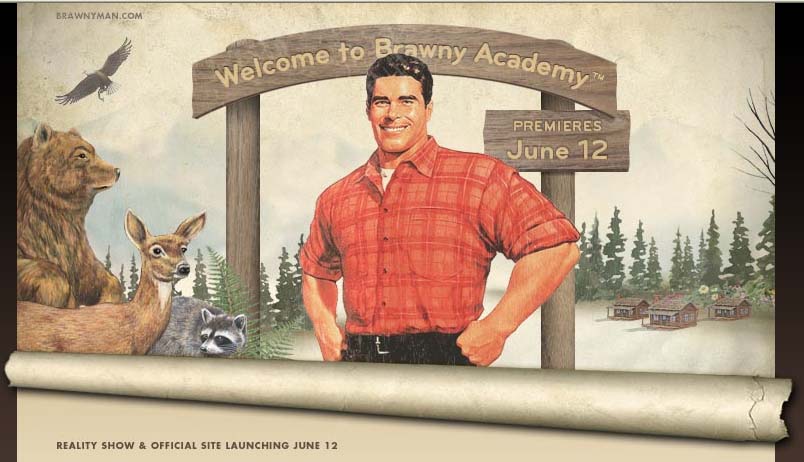
Brawny Academy.
June 12th - Episode One of Brawny Academy Available Online Today.
Follow the trials and raised expectations of the Brawny Man’s charges here.
Half of Americans Believe Humans Did Not Evolve
 Almost Half of Americans Believe Humans Did Not Evolve; Religion is major predictor of attitudes toward human origin
A recent Gallup Poll shows that almost half of Americans believe that human beings did not evolve, but were created by God in their present form within the last 10,000 years or so. These conclusions are based on responses to a specific Gallup Poll question that provides respondents with three alternative explanations for the "origin and development of human beings." AKI COMMENT: Have I mentioned to everyone about "Evo-Terrestrialism"? Don't be fooled by superstitious religions and pseudo-science - man was placed here by Aliens! Pull the shroud from over your eyes people!
Trend: Pop Faith: Battle Cry
Teen Christianity is the new cool, and can be considered a legitimate success, inspring youth to movements like mass vows of virginity and “purity rings”, to impassioned "defense" against the corrosion of non-christian messaging (pop TV and MTV).
Witness BattleCry for a living example of the extents of US teens' passion for Jesus.
The Battle Cry Campaign is driven by several Christian ministries and church leaders and led by Teen Mania Ministries. Teen Mania's goal is to provoke a young generation to passionately pursue Jesus Christ and to take His life-giving message to the ends of the earth.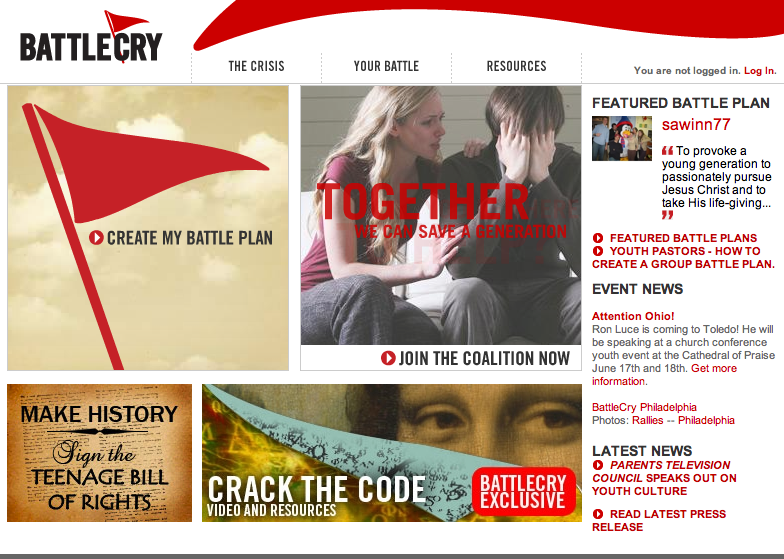
Trend: Consumer Experience Sells
What drives top-line growth and above-average profits? Peer Insight, the service innovation consultancy, has devised a chart and table (below) that correlate and index a portfolio of companies that provide great consumer experiences (cX) with sales and stock-market performance. The evidence speaks for itself: the likes of Starbucks and Whole Foods Markets, which focus on their consumers' needs and wants, fuel their innovation and profits by keeping the customer in mind.
via BusinessWeek's IN Special
Friday, June 09, 2006
Mickey Mouse fruit.

Disney has recently dumped McDonalds as a partner and is now re-branding fresh fruit. Sold in the US and Europe the fruit will have removeable stickers that kids can collect.
"We are trying to develop 'better for you' ranges for kids," claims Andy Mooney, chairman of Disney Consumer Products.
I don't know what the pricing will be but it seems likely that the sticker will command a premium and it's not exactly like fruit isn't available to kids without Disney's help. Surely education efforts would make a bigger impact on helping kids eat better than re-branding fruit?
via WARC
Thursday, June 08, 2006
Trendspotting with Demetri Martin (Daily Show)
Consider this the companion piece to Adrian's post about the new young wines. I particularly like Demetri's un-Powerpoint charts.
Trend: User-Created: Hip-Hop's "Unwelcome Attention"

In a special edition of The Economist Magazine, the managing director of Louis Roderer Cristal addressed the popularity of the sparkling wine brand amongst Hip-Hop artists. If you don't know, you can't watch an MTV hip-hop or R&B video without seeing "big pimpin'" rappers "ballin'" on camera with bottles of high-priced cognac and champagne. And shouting out the brandnames. For Free.
In an article titled "Bubbles & Bling" Frédéric Rouzaud, the managing director of Cristal, was less than thrilled at rappers' fondness for the posh drink.
"What can we do?" Rouzaud told The Economist. "We can't forbid people from buying it. I'm sure Dom Perignon or Krug would be delighted to have their business."
The article further labeled the constant Cristal patronage by rappers as "unwelcome attention."
According to AmericanBrandstand.com, the pricey champagne was the 8th most mentioned brand on Billboard's Top 100 chart in 2005 with 35 mentions, being promoted by the likes of Kanye West, Trina, Lloyd Banks, The Game, Mariah Carey, and others.
AKI COMMENT: Whaddya do when a whole culture insists on name-checking your product (for free) in their songs, and pouring your product (for free) in music videos, and showcasing your product (for free) backstage and in the VIP Rooms at the club? Dang, what a big problem you've got. How many liquor brands have I worked for in my life that paid me to strategize some secret-sauce to get that magical hip-hop endorsement?  While I respect Cristal's dilemma - it ain't upper-crust when the 'hood is sippin' it outta plastic cups. I do think what you do firstly is DON'T COMMENT NEGATIVELY ON ANY CONSUMER PASSION, ANYWHERE, FROM ANYBODY. Sure, you can choose not to goose it - don't send a complimentary crate of the juice over to Snoop's house (you sure bout that, boss?). But getting on the mic and clowning consumer passion for your product just seems ill advised no matter how you cut it (remember, this is $600 joy juice, here).
 This move is faulty particularly, when:
A)the cliche upper-crust consumer you think you sell to (let's call him Cadbury) has no clue about this subculture endorsement anyway, and
B)don't be fooled, Cadbury (if he is under 40) has all the CD's by these artists bumpin' in his Maybach (or at least his sons and daughters do) and he aspires just as much to the hip-hop fantasy as the 'hood aspires to the yachting lifestyle. Look closely at Paris Hilton's invite list, it ain't Bif and Muffy at her party, it's 50 Cent and Dr Dre posing in W Magazine in golf shirts on the lawn. And
C)you're dissing guys who are professional speakers, constantly played on radios, on tv, on mics, every nite, in every city, before packed crowds, globally...they can just as easily make your brand the butt of every rhyme, too. Why pick a fight?
Ironically, it is Cristal's type of blatant exclusionary snobbery that makes the hip-hop nation chase it for admission. It is quite possible this rebuke of "unwelcome attention" MAY NOT halt sales in the 'hood. Go figure...
Yet the fact that Cristal's dismissal may not affect hip-hop's demand is purely accidental on Cristal's part.
Consider smart brands like Louis Vuitton and Courvoisier who've recently learned to track in both spheres of influence. Their ads and initiatives have definitely gotten a shade "ghetto fabulous" and made the best of an unstoppable train. Consider, too, the 'hood is gonna purchase pirate product or purchase some near-lux copycat brand with, or without you. Well, why let pirates get paid off of your brand? Put J-Lo and Busta on. Gloss 'em up and get paid off of a good thing that you never saw coming. Money spends no matter who is giving it - work with it, don't fight it.
Mr. Rogers Goes to Washington
Check out Mr. Roger's rather persuasive sell-in to the US Senate in 1969 to fund a newly developed PBS. Well worth your 6 minutes at the pay-off. This speech goes up there amongst Churchill and Lincoln!
Trend: Bankrupt!: Bank of Mom+Dad Redux

According to the third annual survey by Citi Credit-ED/Synovate, a national survey of more than 1,000 college juniors and seniors reveal that—as in past years—today’s college upperclassmen continue to embrace a youthful optimism toward their financial security. However, parents might be surprised by the role they’ll play to help attain this lifestyle:
-A majority think they will earn $30,000 or more the first year out of college, one-third think that their earnings will be at least $40,000.
-4 in 10 expect to have an affordable lifestyle within three years of graduation.
-64% are expecting at least some financial support from their parents after graduation.
-Over a quarter of upperclassmen expect to live with their parents after graduation – a 10% increase from 2005.
With the prospect of having to manage their own finances after graduation, college upperclassmen recognize the importance of financial knowledge—but are less confident about their own knowledge, compared with previous years. But they are showing an increased desire to become credit savvy:
-Less than half of those surveyed this year think they have sufficient knowledge to manage finances and credit responsibilities after graduation.
-Less than half consider themselves to be “good” at managing their day-to-day spending.
-Nearly a third are interested in increasing their knowledge about sensible credit management.
AKI COMMENT: As I have been noting throughout my ongoing series of TREND: BANKRUPT! posts, AMERICAN'S FINANCIAL EXPECTATIONS WILL SOON NOT MEET OUR ABILITIES.
Will post more soon on rising youth debt and our collective accrued retirement debts.
Wednesday, June 07, 2006
The new wine, cheap and proud of it

Wired has a good summary of the new wine market that Yellow Tail kicked off a few years ago. It serves the younger crowd (and people like me who know nothing about wine), and offers wines that are a sharp contrast to the traditional and very serious wines that used to dominate. With names like Monkey Bay, Fat Bastard and Goats Do Roam, they are also changing traditional wine marketing, sponsoring rock concerts and surf events.
For their part, some of the traditional wine manufacturers are trying to respond in kind. Ravenswood now sponsors NASCAR, and Mondavi has hired one of the Queer Eye guys to tout their stuff.
It's a classic David and Goliath story except the Davids are largely owned by big corporations.
Tuesday, June 06, 2006
Guardian launching in the US

According to the Guardian:
The Guardian plans to expand its print and online presence in America as part of its ambition to become the biggest liberal voice in world media.
This will be an interesting launch to follow. Apparently Guardian Unlimited has a big following here. I wonder what kind of audience they'll ultimately build? I'm sure it will be the usual higher income, highly educated, metropolitan crowd but will they get beyond that? And what will advertisers do with a paper that's unashamedly leftist?
The phone to be the last device standing?

Seems that in gadgets, there can be only one, and that will be the phone. The BBC reports on a study done by Nokia indicating that standalone digital cameras and MP3 players are likely to be replaced by phones with expanded functionality.
As reported here, the phone has already replaced the wristwatch and now:
The study found that 44% of people already use their handset as their main camera.
The days of the MP3 player also look to be numbered, as 67% of those questioned said they expected their phone to replace their portable music player.
I wonder if Apple or Canon sponsored research would have come to the same conclusions?
Monday, June 05, 2006
Trend: Gas Watch: Who Killed The Electric Car?

Another documentary expose is soon to play at your neighboring independent cinema. "Who Killed The Electric Car?" focuses on Detroit's strange failure to get on the bandwagon with sustainable autos. Oddly enough, this movie reminds us that originally America's prevalent cars were, in fact, electric. And then they suddenly weren't...And here we are.
Funny how we ignore the gift solutions provided us at the get-go.
http://www.whokilledtheelectriccarmovie.com/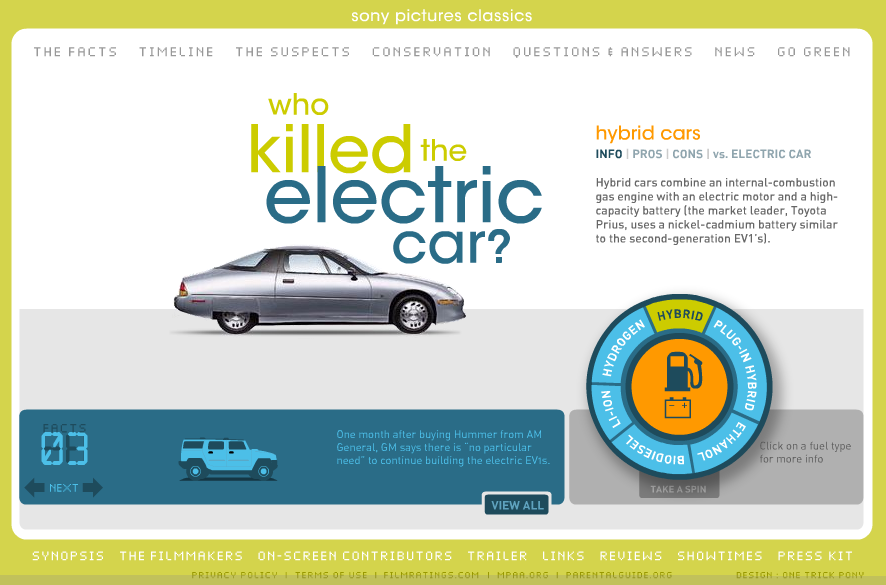

The end of the cool hunter?

Grant McCracken on the demise of cool hunting (www.cultureby.com):
Who killed the cool hunter? I think contemporary culture did. It got more complicated, in the process outstripping the cognitive abilities of even those who claimed guru status. And the knowledge of contemporary culture became more distributed. Increasingly, even the corporation had a clue.
Useful in their brief moment, cool hunters would eventually be remaindered by historical forces beyond their control. Those who live by the trend, apparently also die by it. And somehow I think that's fair. Surely contemporary culture is too interesting, important and difficult to be represented by catching phrases, exclamatory declarations and a haughty self importance. Cool hunters, you are now removed from fashion.
I suspect McCracken, who is an ethnographer, may have taken just a small amount of personal satisfaction in pronouncing the "end" of a competing discipline (no, they are not the same, but both compete for corporate attention and dollars). I do think he is right though. The rockstar personas of the Faith Popcorns tended to overshadow any real or at least consistent success.
We all delighted in the well-crafted phrases (myself included) designed to capture the zeitgeist of the moment. Or maybe that was the issue. I think in too many cases, cool hunters attempted to ascribe a zeitgeist to what were simply unpredictable fads and fancies with no deeper cultural meaning. When I see these phrases now, they have a Powerpoint-ready triteness to them, even when on the odd occasion, they are actually attached to real insight.
Thursday, June 01, 2006
iPod share has not translated to increased Mac share.

Appleinsider reports on a recent IDC study that shows despite impressive iPod growth, Apple worldwide share in the computer area has actually slipped from 2.2% to 2.0% and share in the US is fairly flat at 3.6%.
While it's disappointing for the Mac fans that more people haven't gotten the religion, share is only one of evaluating success. A look at operating margins paints a different picture. Apple's margin is almost double (12.27%) that of Dell (7.45%) the current share leader. In stable, commoditized, categories, strong brands are far more effective at protecting margin than growing share.
However, you have to wonder what it is about the brand that feels like it's "not for" so many people. The technological barriers don't really exist anymore and the product is acknowledged as superior. As much as we in the industry admire what they've done with their brand, there's clearly something in it that isn't inclusive for the minstream.
Subscribe to:
Posts (Atom)


 Seed Newsvine