In the United States, Halloween has become the sixth most profitable holiday (after Christmas, Mother's Day, Valentines Day, Easter, and Father's Day) for retailers.
So brand Halloween is strong, and marketers have a chance to use holiday insights to meet consumer needs. Some have: Comcast created a new channel called FearNet to satisfy the desires for scary-movie-lovers. Other brands have met the needs of the costume-craving and –confused, such as recently Captain Morgans Costumes and last year Burger King Masks.
For the most part, companies leave that to the candy-makers like M&M’s and fantasy-creators like Disney.
As story-tellers, it seems an opportunity exists to use holidays and this one in particular to extend (and test) a brand’s elasticity and complexity, possibly making some sweet mullah in the process. Most importantly, it is a time to show your personality and bring your culture out.
Hey, people do it. Just look at the Today’s Show, to see the link between traditional entertainment company/brand to entertainer/person/brand. Hosts Matt Lauer and Al Roker were Pirates of The Caribbean characters and Meredith Viera was the Little Mermaid. While Anne Curry was Cher and Natalie Morales was Madonna.
They also highlight some observations about the importance of individual expression within a safe community. There’s no denying individuals take the opportunity to extend and voice their brands. Sometimes it’s just being the hot you Playboy bunnies. But notice the ease and necessity of doing it in a group (i.e., girl scout troops, Wayne & Garth, female firefighting squads, Reno 911 officers, etc.) There are more examples of women than men, but in addition to wanting strengthen and security in numbers more, I believe it’s also a testament to them having their shite together.
In any case, a great costume can be judged on a number of criteria, but are almost always a great conversation piece. Hits this year, from my perspective, include: Kim Jong Il (based on relevancy and amazing hair and glasses), Hulk Hogan (also a larger than life character that’s has cultural relevance – new show Hogan Knows Best – and performance - the guy really “sold” it), Shots (depth, variety, detail, creativity for the buttery nipple, purple hooter, and other 7 ladies), and Papa Smurf (dedication – full blue body paint – and detail – could not be confused with a member of the Blue Man Group).
But whether you (and your crew) are (is) the most original or most obvious, the holiday is, inherently (read as: has been commercialized/crafted to be), a social lubricant.
Halloween provides brands an opportunity for both transformation and interesting discussion. It’s a chance to have fun and not take itself too seriously, to pay tribute to and shape culture, to join the conversation. I believe it’s worth thinking about what opportunities other holidays provide.
Share ideas that inspire. FALLON PLANNERS (and co-conspirators) are freely invited to post trends, commentary, obscure ephemera and insightful rants regarding the experience of branding.
Tuesday, October 31, 2006
Halloween and brands
Ad Agency Deathwatch: Google Rising
Imagine you're Volvo's top US advertising executive, responsible for an ad budget of around $100 million (€78.59m; £52.72m). And you want to talk to an expert with new media savvy and empathy with a prime customer target group.
Who do you talk to? A creative boutique? An online hotshop? One of the specialist new media scions of Omnicom, WPP, Interpublic, Publicis and Havas?
None of these if you're Volvo's Linda Gangeri, who like those seeking Ralph Waldo Emerson's "better mousetrap", made "a beaten path to the door" of . . . Google.
Impressed by the Californian search titan's recent ingestion of YouTube Gangeri cold-shouldered Madison Avenue's finest in the belief that she might find the "better mousetrap" at Google.
Volvo, whose image is more usually associated with the comfortable bourgeoisie, will next year launch a new model targeting the hip, twenty-something crowd - Googlers personified.
Jetting-in from the West Coast to Google's recently opened New York offices, Gangeri told the Googlistas: "This is a target we've never reached before and one you cannot reach via traditional marketing messages - they reject it. We look to you and challenge you, with Google being more of that young, targeted mind-set."
Patrick Keane, Google's director of product marketing, was in no mood to disagree with such dollar-dripping enthusiasm. Unable to believe his luck, he took up Gangieri's refrain.
"There's probably a false assumption in the marketplace that Google is a bunch of machines in Mountain View [California] and we don't have relationships like you might see at Conde Nast up the street or at ABC television," Keane responded.
Elsewhere, however, there was less enthusiasm. Timothy Hanlon who, as svp of Publicis Groupe's Denuo new-media consulting division, bestrides the gap between old and new media, assessed the Google incursion.
"They're trying to take the DNA of search marketing and apply it to other kinds of advertising," he said, adding that the larger dollar-pot in traditional "brand-marketing budgets" is a natural target for Google.
While Jason Clement, associate director of search engine marketing at Aegis Group's Carat Fusion, was in counter attack mode: "The scariest thing about Google is they don't know what they don't know.
"There's a difference between a Harvard [graduate] mathematician and someone who's been selling ads for twenty years. The mathematician is smarter, but if you want Coca-Cola's dollars, the guy selling billboards for twenty years is the one you want."
Surveying the upcoming Battle Royal, observers of the media scene predict that few prisoners will be taken.
via WARC and Washington Post
Monday, October 30, 2006
Event: U of M Professor discusses the social web
For us locals, the Minnesota Interactive Marketing Association is sponsoring a chat about the ever-changing nature of the internet, social media and all of the buzzwords we love to ponder and eschew. 7 p.m., Thursday over on the St. Paul campus.
"No longer is the Internet merely for sharing facts and figures; increasingly it’s for creating connections with people. The hundreds of social networks springing up all over the Internet are changing how people keep friends, find jobs, enjoy hobbies and even choose life partners. What is the social web? How did it happen? And why is it so important?"
Sunday, October 29, 2006
Industry: Analyzing CNN "Actual News" Content
Reprint from Daily Kos which critiques the level of "actual news" featured on websites after you take out ads.
Let's take a look at their home page (from yesterday's "above the fold" CNN home page):
CNN HOME PAGE
Okay, now let's find all of the advertising, including cross-selling and up-selling to other CNN shows and services. Here's what we get:
CNN Advertising

And now lets find all of the dog-bites-man sensationalism, gossip, trivia, and other non-news.
CNN Sensationalism
And now the actual news... wait for it...
CNN Actual News
That is the SUM TOTAL of actual news presented on the above-the-fold CNN home page.
This is what their home page would look like if it was presented with just news:
Pop Faith: ATMs for Jesus

LA Times reports: In bids for relevance, Pastor Marty Baker, of Stevens Creek Community Church, makes sermons available as podcasts, regularly plays Aerosmith's "Dream On", and discusses the spiritual wages of lunching at Hooters. He has also installed ATMs in the church lobby.
Kiosk giving has gradually gained acceptance among his upper-middle-class flock. The three kiosks are expected to take in between $200,000 and $240,000 this year — about 15% of the church's total donations.
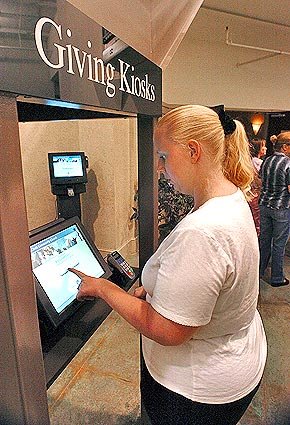
At church services, Baker said, the next few years could be comparable to another upheaval centuries ago, when offerings of grain and animals were replaced with what was then the newfangled medium of money.
"I'll bet that caused a stir, too," he said, chuckling.
See previous link about God's credit acceptance networks, as well as other Faith Web 2.0 movements

ID Theft: This Week In ID Theft
Industry: 25 Stickiest (Brands on the Web)

Internet users at home and work visited the top 25 parent companies and stickiest brands for September. Nielsen//NetRatings tracked the brands with the highest number of unique visits and time spent on their sites.
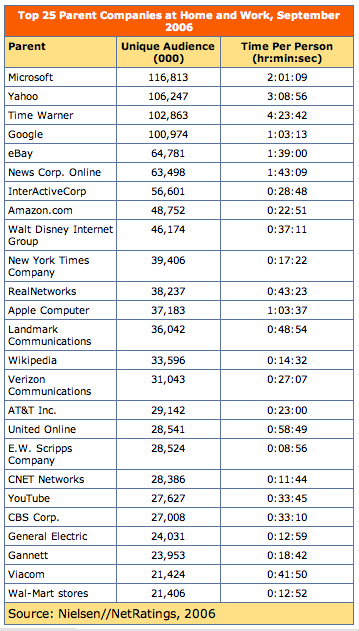
Nielsen//NetRatings uses a sampling methodology through its MegaPanel of Internet users.
via clickz
Saturday, October 28, 2006
New account planning entry on Wikipedia

Someone, perhaps a reader, has just recently written a lengthy and fairly comprehensive definition of planning. It includes a number of different sections and links to us (thanks!).
What it needs now is a present/future perspective about where the discipline is heading. Anyone up for contributing?
Conscious Consumption: (Product)RED Rising

The (Product)RED train just keeps on a chuggin' since last time we checked */
**/
***
iPod Nano Red, MySpace Red, Flickr Red
Gap Red has lined up the requisite list of celebs for its ad campaign: Chris Rock, Dakota Fanning, Jennifer Garner, Penelope Cruz, Steven Spielberg, Don Cheadle, and Mary J. Blige.
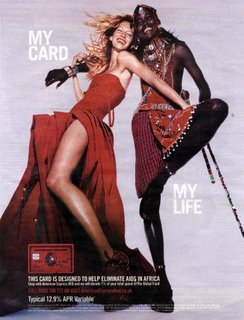
While I have obtained no empirical data, Amex Red seems to be gaining in popularity and sentiment.

Politics 2.0: Google Election Maps
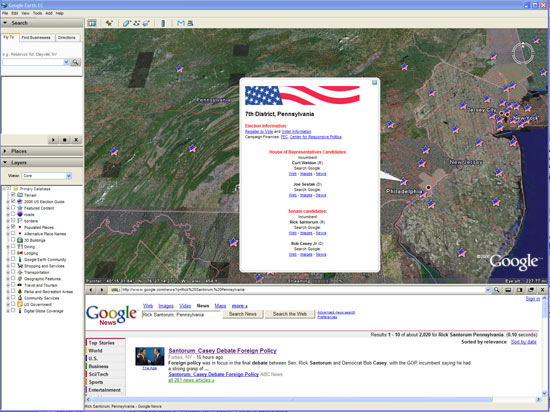
Google is offering a mashup that combines its popular Google Earth mapping program with information about the U.S. congressional races coming up in two weeks.
The Google Earth 2006 election resource tool, unveiled early Monday, indicates the country's 436 congressional districts with stars on the popular 3D map of the country. Clicking on a star pops open a bubble window that has information on the candidates in that race.
The window also includes links to news, images and Web search results on candidates, as well as to information on where and how to vote and campaign finance reform.
"Our hope is that young people using Google Earth will…make better, informed choices," said John Hanke, director of Google Earth and Google Maps.
The project was the brainchild of two members of the Google Earth team who created it during the 20 percent time allotted each week for engineers to work on special projects of their own design, Hanke said.
via CNet
AKI COMMENT: Try a slightly easier interface at Washington Post, as you will likely need to download Google Earth applications onto your computer to use.
And did anybody else notice the 20% WORKTIME COMMITMENT TO INNOVATION POLICY at Google? More on that later...
"Don't Panic": Ecological Debt
Global ecosystems face collapse due to societal "Ecological Debts"
Current global consumption levels could result in a large-scale ecosystem collapse by the middle of the century, environmental group WWF has warned.
The group's biannual Living Planet Report said the natural world was being degraded "at a rate unprecedented in human history".
Terrestrial species had declined by 31% between 1970-2003, the findings showed.
It warned that if demand continued at the current rate, two planets would be needed to meet global demand by 2050.
The nations that were shown to have the largest "ecological footprints" were the United Arab Emirates, the United States and Finland.
Paul King, WWF director of campaigns, said the world was running up a "serious ecological debt".
"It is time to make some vital choices to enable people to enjoy a one planet lifestyle," he said.
The findings echo a study published earlier this month that said the world went into "ecological debt" on 9 October this year.
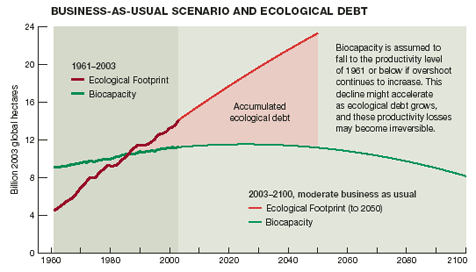
By 2050 accumulated ecological debt may be irreversible
The study by UK-based think-tank New Economics Foundation (Nef) was based on the Ecological Footprint data compiled by the Global Footprint Network, which also provided the figures for this latest report from the WWF.
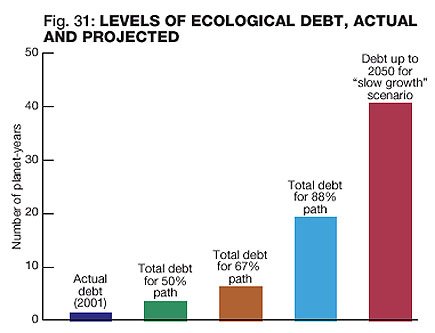
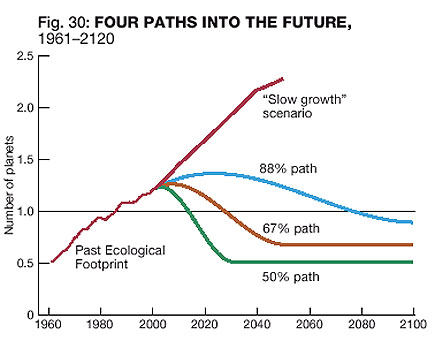
Read more on proposed 'Pollution Penance' tactical alternatives to pay down our individual and collective Eco Debts here and here
via BBC, ABC News, and WWF
Friday, October 27, 2006
AAAA CREATIVE SUMMIT-MINNEAPOLIS
Friday, November 10, 2006
The AAAA's Creative Summit
An advertiplay in 3 acts
@ The new Guthrie Theater, 818 South 2nd Street, Minneapolis
November 10th, 12:30 - 4 p.m.
Act I: Joe Dowling, Artistic Director, Guthrie Theater
Act II: Pat Fallon and Fred Senn, Chairman and Founding Partner, Fallon Worldwide
Act III: David Droga, Founder and Creative Director, Droga5
www.06creativesummit.com
Second Life Traffic Soars
MarketingVox reports on new Hitwise research that shows traffic to the virtual world site skyrocketing in the past few weeks amidst growing media attention and significant interest from the corporate world. Interesting to note, over the past month or so, the percentage of visitors to the site in the 55+ age range has jumped, from around 6% to 15%, while the 18-24 crowd seemed to fade, dropping about 7%, from 33% of visitors to 26%.
From the article:
The share of U.S. Internet searches for "second life" last week (ended Oct. 21) shot up 73 percent from the previous week, and visits to Second Life more than doubled from the two weeks ended Oct. 7 to the two weeks ended Oct. 21, according to a Hitwise blog post. Year over year, visits to SecondLife.com were up 219 percent (week ended Oct. 21, 2006 compared with week ended Oct. 22, 2005).
For the four week period ended Sept. 23, about 32.7 percent of visitors to SecondLife.com were between the ages of 18 and 24, and only 5.6 percent were over 55. Nearly a month later, for the four weeks ended Oct. 21, those over 55 constituted 15.1 percent of Second Life visitors, whereas visitors in the 18-24 group decreased seven percentage points, to 25.7 percent.
"It will be interesting to see how many of these older visitors become players in Second Life - right now the appeal of Second Life skews to those under 45. An older, and potentially more moneyed, player set in Second Life could attract a different caliber of advertisers to the game," writes LeeAnn Prescott, Hitwise research director, in her blog.via MarketingVox
Cashless Society: NYC Mobile Trial
Been awhile since any updates on the mythical Mobile Cashless Society. Save for the occasional "technology, wow" stories on CNN or MSNBC trumpeting the coming Star Trek-future, I've been rather disappointed by America's slooow pace of adoption of innovations such as the Phone Wallet.
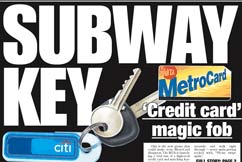
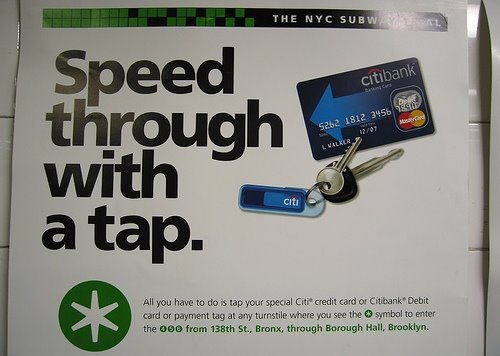
It's been three months since the MTA, Citi and Mastercard unveiled the contactless payment system in NYC.
The system has been in limited trial (presumably successfully), and now they have unveiled the next part: The NYC Mobile Trial. If you have a Citbank Mastercard with Paypass - and a Cingular account - you may be able to sign up and use your cellphone to pay your fare.
Tap your NFC (Near Field Communication) enabled mobile phone on the payment reader located on the front of the turnstiles. The contactless-enabled turnstiles will have a payment reader featuring the green subway trial symbol. These turnstiles also feature a “Turnstile. Turbostyle.” Label at about eye level and a subway trial symbol banner across the top of the turnstile.

If you're in NYC, sign up here.
AKI COMMENT: You know where I stand on this: "'bout time" and "gimme mine!". Further, the sooner that contactless merges with ubiquitous tech like phones and gadgets we already carry in our pockets, the sooner the behaviour can be adopted. Noone needs additional and separate key fob gadgets for cash, gas, tolls, etc... Now if we can only get this stuff into our clothing we'll be really fluid.
via Gothamist and ePayment News
Thursday, October 26, 2006
Politics 2.0: Google Bomb
MediaPost reports: A coalition of Democratic-leaning bloggers are planning an en masse search engine optimization campaign, in the form of "Google bombs," in hopes of highlighting negative stories about GOP candidates. The bloggers plan to manipulate the search engine's results via blog posts that link the candidates' names to unflattering articles.
Past political Google bombs have included linking the biography pages for President George W. Bush and former President Jimmy Carter to the phrase "miserable failure," and the John Kerry senatorial Web site to the word "Waffles" during the 2004 Presidential campaigns. A Google search on the name "George Allen"--a Republican U.S. Senator from Virginia running to retain his seat--now returns his official Senate page as the top organic result. But if some bloggers have their way, the top result will instead be "New 'N Word' Woe For George Allen," a CBS News article from September, highlighting the Senator's alleged use of a racial slur.
But, although "bombing" has worked in the past, Google says it has recently tweaked its algorithms to prevent people from bombing. "We make changes to the algorithms to make the searches better," a spokesman said. "Invariably, this does take care of some of these attempts at Google bombing which are not true organic results."
This election cycle's Google bombing is being masterminded by Chris Bowers, author of the popular liberal blog MyDD.com. On Tuesday, Bowers posted the code for 52 links to news articles and Wikipedia entries detailing scandals that Republican candidates and incumbents for the Senate and House have been involved in. Bowers on Tuesday asked that blog authors post the links in their own blogs with the candidate's name as the link text--thus creating inbound links on those articles, and driving up the page rank for those pages and raising them in Google's natural search results. 
On Wednesday night, Bowers advised blog authors to add the new "bombing" links to their blog templates, which would retroactively add them to every post they have ever made, creating still more inbound links to the negative articles.
Bowers also is planning a paid search campaign to complement the Google bombing, but declined to discuss the details of the keyword buy. On his blog, Bowers stated: "I don't want to tip off right-wingers."
via MediaPost
Politics 2.0: Video the Vote

Video the Vote seeks to report disenfranchisement in real time through the use of everyday citizens with cameras. Essentially, they're taking citizen journalism to a mass level by getting everyone in on one particular story (as opposed to many people in on many different stories). It will be interesting to see the response - both from participants eager to root out problems and from authorities who are supposed to be preventing the problems in the first place. Also of interest: how will multiple citizen journalists shape the story? While there is still a set point of view to the piece, the influence of many reporters could alter the story.

Wonder if this trend will continue; more stories featuring multiple vantage points could be really cool, but will a unified POV still be necessary for truly compelling stories?
Check out Video the Vote's YouTube video below:
Wednesday, October 25, 2006
Web 2.0: Bush Says He Uses “the Google.”

Think Progress has uploaded a clip from a CNBC interview in which President George Bush describes his use of search engine Google.

Transcript:
HOST: I’m curious, have you ever googled anybody? Do you use Google?
BUSH: Occasionally. One of the things I’ve used on the Google is to pull up maps. It’s very interesting to see — I’ve forgot the name of the program — but you get the satellite, and you can — like, I kinda like to look at the ranch. It remind me of where I wanna be sometimes.
AKI COMMENT: Sigh...
Web 2.0: Ask A Ninja "Matures"
Ad Age interview about new media maturity of the guys from AskANinja.com
Only a year ago, Los Angeles-based improv artists Douglas Saline and Kent Nichols were out of work and nearly destitute. After fruitlessly trying to sell a ninja movie script to Hollywood, the duo decided to produce a snippet of content themselves, offer it directly to consumers for download and see what happens. Today, they run an expanding media property selling ad space at $50 CPM to companies such as Sony and Warner Bros.

Today, the venture has become much more than a simple podcast. Messrs. Saline and Nichols have together produced 47 four-minute "Ask a Ninja" podcast episodes that average 200,000 U.S. downloads a week. Askaninja.com, where fans can watch video versions of the Ninja, pose questions and buy branded Ninja gear, has 3 million visits a month. And Ninja has been quoted on the floor of the U.S. House of Representatives regarding the net neutrality issue and delivered an official movie review on NPR.
According to podcast advertising rep firm Podtrac, and 57% of the audience is between ages 19 and 34 and 83% is male.
via AdAge
Tuesday, October 24, 2006
User-Created: Inspiring a Car Culture Within Second Life
Reuters reports on the latest in corporate marketing ventures into the virtual world of Second Life. Pontiac is staking their claim, albeit in a slightly unexpected fashion. Their angle in is buying virtual real-estate: 6 virtual islands that they will lease out for "free" to residents in exchange for the promise that those new land-owners will breed a "vibrant car culture within the community".
Dubbed Morotari Island, Pontiac plans to issue out "parcels of land around Motorati Island to Second Life entrepreneurs and artists who wish to create their own projects devoted to car culture." Users who want to get in on the bid can go to the islands Morotari life website (still under construction), to pitch their ideas in hopes of getting a piece of the land on which to lay out their creations.
I think this is a good example of marketers realizing they need to be a part of the conversation in the world of new media and not try to take it over. Compared with other corporations that have simply set up shop within SL to operate as they would in the real-world, GM seems to have put more thought into what a brand may need to do to in order to truly integrate itself into this type of new media/virtual world atmosphere. Allowing residents to incorporate Pontiac as part of their own user-created projects provides for a much different level of interaction than simply seeing a billboard on the street or a sky-scraper on the horizon. Enhancing and facilitating a consumer experience rather than creating and controlling it for them. I like it.

From the article:
"Our mission is to work with the Second Life community to create a place for car lovers that doesn't exist today," said Mark-Hans Richer, marketing director at Pontiac. "However, our approach isn't to be a 'me too, marketer' and simply have a presence in the space. Rather, we want to empower the car community in Second Life and develop with them in a unique and meaningful manner. We aren't completely creating the experience -- the Second Life users are. We're just providing the inspiration."
In addition to the community based projects, Pontiac will create its own presence on the island. Plans are in development to build a futuristic Pontiac "dealership," selling customizable versions of the newly introduced Pontiac Solstice GXP. Owners can then test their new purchases on a high- performance test track, fully modify them and even showcase them in a public gallery. The Pontiac Garage music stage in New York City's Times Square will be replicated in this space and act as a venue for live music performances by real artists in the form of their Second Life avatars.
"Our hope is to unleash the community's passion for cars," said Tor Myhren, executive vice president, executive creative director at Leo BurnettDetroit. "We envision weekly competitive driving events, drive-in theaters playing car related films, machinima film studios, car-themed fashion shows, live concerts, drive-in restaurants, you name it. If an idea relates to any aspect of car culture, we intend to give the community the means to make it happen."
via Reuters
Monday, October 23, 2006
Starbucks: Premium Blend Culture
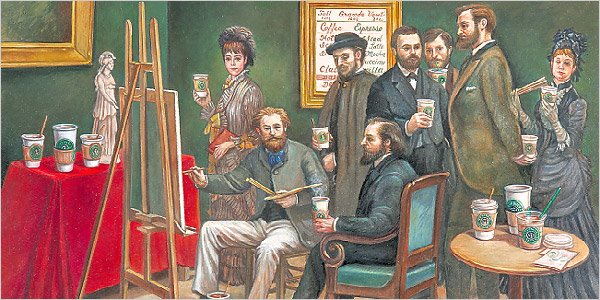
NY Times analyzes Starbuck's ever-evolving brand of "Premium Blend Culture"
Culture: Brief Breakbeat History
18 minute video explaining the history of the 'Amen Break', known in drum&bass and electronic circles as "the world's most famous drum beat"...uhm, in line behind Lyn Collin's 'Think', and James Brown's 'Funky Drummer', but anyways, i digress...
Beta vs VHS: Round 2 for the Digital World
A new BusinessWeek report discusses the latest battle in video players fighting for high-tech, digital savvy consumers. DVD seems to be the popular choice in video media formats for the moment, but others are creepin up. From this article, seems to me compatibility issues may still hinder wider acceptance of these new technologies. And let's not forget the (up to) $1000 price tag on these next-gen players. I'll need to check these out in person, and maybe its the skeptic in me but I don't think the tech is that overwhelming to justify a total switch and repurchase of the many DVD's I have on one of these new formats. After all, I'm still plotting on when to buy my first plasma-screen TV. Baby steps.
Article via BWonline:
The resolution on DVD players is light-years behind what the latest crop of high-definition televisions can do. The next-generation video formats, Blu-ray Disc and HD-DVD, have 5 to 10 times the capacity of old DVDs. Ready to switch? Here's the catch: Blu-ray won't work in HD-DVD players and vice versa. Manufacturers have hinted that future players could show both, but for now you'll have to choose sides.
CONTENT
Four of the seven major Hollywood studios support the Blu-ray format exclusively, while only one, Universal, has taken HD-DVD's side. (Warner Bros (TWX ). and Paramount work with both.) Blu-ray discs hold a maximum of 50 gigabytes, HD-DVD,just 30 gigabytes. Advantage: Blu-ray.
PRICE
Blu-ray players hitting the market, such as Sony's (SNE ) BDP-S1 ($999), are twice as expensive as entry-level HD-DVD models. (All prices are suggested retail except where otherwise noted.) The only Toshiba model with 1080p output, which all the Blu-ray players have, is also priced at $999, however. Toshiba says it will be cheaper to manufacture HD-DVDs than Blu-ray discs, but Blu-ray folks dispute that. Advantage: HD-DVD.
HEAD START
When a new technology first hits the market, you can be sure it will have bugs. Case in point: Samsung's BD-P1000 ($750 from online discounters), which shipped with a bad chip that marred its image quality. (Samsung says it is fixing the problem.) Meanwhile, HD-DVD champion Toshiba (TOJBF ) is already unveiling its second round of players, the HD-A2 ($499) and HD-XA2 ($999, available in December), sporting sleeker profiles, faster startup times, and better remote controls. Advantage: HD-DVD.
GAMING
It's not all about movies. Sony's PlayStation 3 ($499, available in mid-November) will double as a Blu-ray player. Not to be outdone, Microsoft (MSFT ) is offering an add-on HD-DVD player for its Xbox console ($200, available in mid-November). If the PS3 is a hit, it will help Blu-ray. Advantage: Blu-ray.
Sunday, October 22, 2006
Commercial Interruption: Vintage Kid Packaging
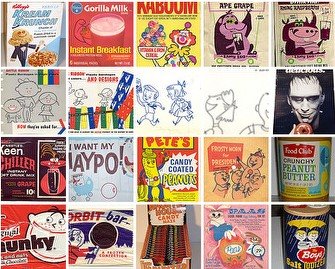
Dan Goodsell, co-author of the book Krazy Kids' Food (Taschen 2003), has the most excellent Flickr set of vintage products for kids. The set includes tons of candy and food you loved as a kid, but have forgotten about until now. The products are from circa 50s-80s, and include cereal boxes, candy wrappers, ice cream boxes, cartoon cells from 1960s cereal ads, etc.
via Boing Boing
Saturday, October 21, 2006
Long Tail: George Lucas Says Phooey To Theatrical Release
The current issue of Variety informs:
"George Lucas has a message for studios that are cutting their slates and shifting toward big-budget tentpoles and franchises: You've got it all wrong. The creator of "Star Wars," which stamped the template for the franchise-tentpole film, says many small films and Web distribution are the future.
And in case anyone doubts he means it, Lucasfilm is getting out of the [theatrical-release] movie biz."We don't want to make movies. We're about to get into television. As far as Lucasfilm is concerned, we've moved away from the feature film thing because it's too expensive and it's too risky.
Spending $100 million on production costs and another $100 million on P&A makes no sense, he said. "For that same $200 million, I can make 50-60 two-hour movies. That's 120 hours as opposed to two hours. In the future market, that's where it's going to land, because it's going to be all pay-per-view and downloadable."
Chris Anderson at Longtail.com adds
That's good news for the vast majority of filmmakers, who have little chance of getting box office distribution today. There's abundant supply of filmmaking talent and abundant demand for their work. The only thing standing in the way is the incredibly limited channel of theatrical release. Fewer than 150 films get distribution on 1,000 screens or more (the definition of mainstream release) each year. Meanwhile, more than 13,000 films are now submitted each year to just one independent film fest--the Tribeca Film Festival--alone. Lucas is right that box-office domination of the movie business seems a throwback to an earlier day of scarcity. Today it's getting cheaper and easier to make a movie. Why shouldn't it be cheaper and easier to distribute it, too?
Lucas further says he believes Americans are abandoning the moviegoing habit for good.
"I don't think anything's going to be a habit anymore. I think people are going to be drawn to a certain medium in their leisure time and they're going to do it because there is a desire to do it at that particular moment in time. Everything is going to be a matter of choice. I think that's going to be a huge revolution in the industry."
AKI COMMENT:
Chad Vader: Day Shift Manager Episode 1
Chad Vader: Day Shift Manager Episode 2
Chad Vader: Nite Shift Manager Episode 3
Chad Vader: Nite Shift Manager Episode 4
Culture: Footworkin' Redux
Alyson represented earlier this month with Chicago's Footworkin' and LA's Krump.
Seth represented way back in the IOI with Harlem's Chicken Noodle Soup.
But Philadelphia got that Wu Tang bidness...check it:
via CouchSessions
Friday, October 20, 2006
Inbox of Immaturity
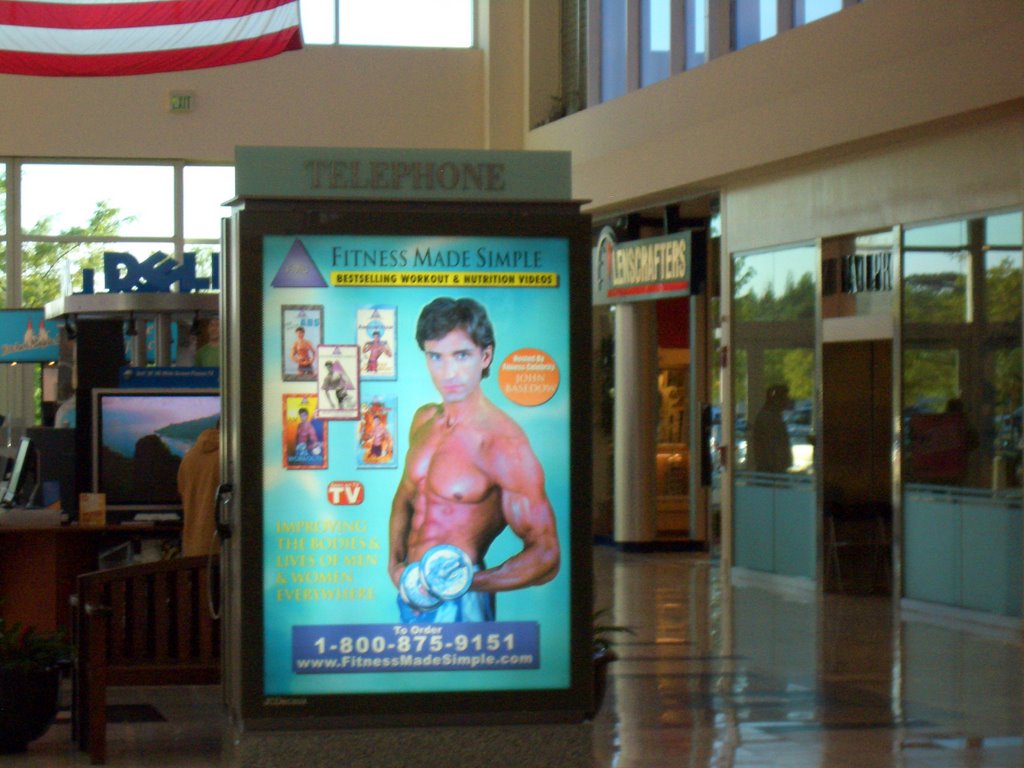
Creatives can use it for mall OOH layouts and the rest of you for inspiration. Bi's, tri's, and even abs.
It's been a few weeks since the last IOI, so hopefully you'll enjoy and find some new ones here:
Indian Thriller
Tootie's Bong
Chicago Bears D on Offense
I-Banking Video Resume
Mike Tyson still crazy as ever
Foley oldey
Mr. T-mail
Drunk monkeys
Finally a Georgetown hoops shoutout
Industry: Internet Addiction
4% of Americans Could Have Internet Addiction
A recent Stanford University School of Medicine study appears in the October issue of CNS Spectrums: The International Journal of Neuropsychiatric Medicine, and lead author Elias Aboujaoude, MD, said it is the first large-scale, random-sample epidemiological study ever performed on the subject of Internet addiction.
Among the study’s notable findings:
•Nearly 14 percent of participants—or roughly 1 out of 8—said they find it difficult to remain away from the Web for days at a time.
•More than 12 percent often or very often stay online for longer than they intend.
•More than 12 percent have felt some urge to cut down on Web surfing.
•Almost 9 percent have at some point tried to hide their surfing habits from family, friends or others.
•More than 8 percent have attempted to escape some problem or concern in their life via the Internet.
•Just under 6 percent said personal relationships were hampered by their excessive Web surfing.

Aboujaoude compared the effects of some Web users’ compulsive surfing, posting and networking habits to those of substance abuse and impulse control disorders, and said an increasing number of Americans are seeking medical attention from doctors or others to address concerns over their Internet use, according to the release.
via BusinessWire
Shop the Shipping Container
Thursday, October 19, 2006
Politics 2.0: Hotsoup
A new social-networking Web site, aimed at “opinion leaders” in politics and other issues, launched today with a roster of members including former U.S. President Bill Clinton, U.S. senators John McCain and Hillary Clinton and former Speaker of the U.S. House of Representatives Newt Gingrich, writes Grant Gross of IDG News Service in MacWorld.
Hotsoup.com aims to give an online voice to the millions of U.S. residents who keep up with the news and influence the opinions of their friends, family and coworkers. The founders of Hotsoup.com, including Internet entrepreneurs and Republican and Democratic consultants, hope the site will contain information that’s “not filtered, not spun,” said co-founder Ron Fournier, a former chief political reporter for the Associated Press.
The goal is to create smart, civil debate, said three of the site’s co-founders during a preview Wednesday. “Americans are tired of yelling at their TV screens,” said Allie Savarino, a Hotsoup co-founder who also helped start the Sisterwoman.com social-networking site. “They want a voice of their own, and they want someone to listen.”
Hotsoup will include video- and text-based commentary from top political, entertainment and sports figures, and it will allow users to start their own discussions about issues important to them. Like other social-networking sites, Hotsoup also will allow users to create detailed profiles.
Hotsoup will also poll users for their opinions on issues and ask them how likely they are to tell friends about a particular debate they’ve participated in on the site.
The concept has drawn significant interest, even before the site’s official launch. Since July, 22,000 people have preregistered for the site, Savarino said. Members include cyclist Lance Armstrong, Republican strategist Mary Matalin, Massachusetts Governor Mitt Romney and politically active rock musician Jon Bon Jovi.
Hotsoup’s founders said they hope the interaction between their opinion-leader members can influence public policy. “Our nation’s public, business and religious leaders are realizing they need to listen and engage with this community,” Savarino said.
Asked if they’re concerned that the debate on Hotsoup will devolve into something less than civil, the co-founders said editor-in-chief Fournier will attempt to steer discussions that get off track, although they don’t want to cut off debate.
via Experientia
Wednesday, October 18, 2006
Politics 2.0: Politicians and Social Media

USA Today reports
Paul Aronsohn's interns told him to promote his congressional campaign on MySpace, Facebook and YouTube. Len Munsil's teenage children told him the same thing. Danny Stover's young volunteers convinced him.
All three candidates have an active presence on the popular websites, which are emerging forces in this year's elections. YouTube, a video-sharing site, didn't exist in 2004, and networking sites MySpace and Facebook were new and originally catered mostly to college students.
Munsil, a Republican challenging Arizona Gov. Janet Napolitano, a Democrat, let his son Will, 19, and daughter Leigh, 18, set up his MySpace and Facebook profiles. "They said it was a great way to communicate with young voters," he says. "We're looking for any opportunity to reach people inexpensively."
The results surprised him. People who learned about his campaign on the sites, he says, "have gotten involved, are coming to events, showing up at debates." Some polling data suggest he's faring better among younger voters, Munsil says. Napolitano's campaign hasn't added material to her profile on Facebook, and she doesn't have a profile on MySpace. Her campaign ads are on YouTube.
Online converts
Stover, an Illinois Democrat trying to unseat Republican Rep. John Shimkus, wasn't very Internet-savvy when his volunteers began talking to him about MySpace and Facebook. "It wasn't too long ago I had a hard time opening up my e-mail," he admits. He's a fan now, especially after receiving $8,000 in online donations.
Shimkus' campaign website includes links to his Facebook and MySpace profiles. The MySpace link doesn't work, and his Facebook profile includes a note referring readers back to his campaign site.
Aronsohn, a Democrat running against Republican Rep. Scott Garrett in New Jersey, hopes to connect with younger people who don't usually vote. "Whether it means more votes in the end, I don't know," he says. "But it's a new way to reach people."
Garrett doesn't have a profile on MySpace or Facebook.
Profiles on social-networking websites can become platforms for debate, organizing and get-out-the-vote efforts.
They also can be forums for rival candidates, whose supporters often add critical comments to politicians' profiles. Sen. Debbie Stabenow's Facebook profile includes messages from fans, as well as comments chiding the Michigan Democrat for voting to build a wall on the U.S.-Mexico border.
Democratic strategist Chris Lehane says many politicians struggle with how to use the sites. "To effectively do it, you have to do something that is completely inconsistent for candidates: cede control," he says. "When someone comes back at you or puts out information that's inconsistent with your message, you have to take that in stride and go with it."
MySpace spokesman Jeff Berman says the challenge for candidates is to "communicate not only authentically, but in compelling ways that have 'viral' power." A topic that spreads spontaneously online is considered "viral."
Video is the way to do that, says Michael Cornfield, who teaches the Internet's effect on politics at George Washington University. Candidates e-mail ads, solicit money online and use YouTube to debut ads that might not appear on TV.
By 2008, Cornfield says, every campaign will videotape rival candidates during public appearances, and gaffes will go online almost instantly. He predicts members of Congress will videotape explanations of their various votes and e-mail them to constituents who care most about a particular issue.
"YouTube is totally transforming," he says. "I expect politicians to flock to this."
Amplifying support
Andrew Rasiej, a technology adviser for Howard Dean's 2004 presidential campaign, which helped pioneer online fundraising and organizing, says he doesn't think politicians wield the Internet's power most effectively.
"It is yet to be demonstrated that the Internet ... actually changes votes," says Rasiej, founder of the Personal Democracy Forum, an online magazine about technology and politics. "Just because a politician has his own page on MySpace, it doesn't mean he's listening to the social network he's joined." What does work is supporters of a politician "using Facebook or MySpace to amplify their support through a network of friends," he says.
One example of that approach is ProgressNowAction.org, founded three years ago in Colorado. The site allows people to use it to recruit supporters, organize events and post petitions.
The site had 9,400 members at the beginning of this year and now has more than 100,000. An Ohio branch just opened, and more are planned, founder Michael Huttner says.
"This is the future of Internet organizing," he says. "People are having conversations, organizing themselves and having a real effect."
Dee Margo, an El Paso Republican running for a seat in the Texas Senate, has Facebook and MySpace profiles. He says the sites already are boosting his campaign.
"Any time you touch a voter, it's an important aspect of a campaign," he says. "And if this is another method to touch them, shoot, you betcha."
Politics 2.0: Politicians' Campaigns Invade MySpace

USA Today reports
Candidates are using popular websites Facebook, MySpace and YouTube for the first time to give their campaigns free publicity, reach young voters and bypass traditional media. Once they're online, though, they risk being mocked and losing control of their messages.
Facebook.com created 1,400 candidate profiles that listed names, states, parties and offices. Of those, about 300 are updated by candidates or their staffs, marketing director Melanie Deitch says.
What's online can be embarrassing:
• Sen. Hillary Rodham Clinton's Facebook profile has many posts from her Green Party rival, Howie Hawkins, who lists reasons he thinks the New York Democrat should be defeated.
• A Facebook search for "Mike DeWine" turns up the Ohio Republican senator's profile as well as links to several self-organized political groups of Facebook members. One group calls itself "Mike Dewine and (Ohio Rep.) Deborah Pryce are tools," a derisive slang for dupes.
• In an ad only on YouTube and Republican congressional candidate Paul Nelson's campaign website, Nelson says Rep. Ron Kind, D-Wis., voted to fund studies of "the sex lives of Vietnamese prostitutes." Matt Sweeney, Kind's campaign manager, says voters will "see through these kinds of sleaze ads."
The power of the sites was highlighted this summer when video of Sen. George Allen, R-Va., calling a rival's volunteer "macaca" showed up on YouTube. It has been seen more than 250,000 times. YouTube has more than 30 million visitors a month.
Campaigns are still finding ways to tap the sites' potential, says Democratic strategist Chris Lehane, who predicts they "will ultimately revolutionize politics."
About 1 million of Facebook's 10 million regular users read politics features, Deitch says. That's an opportunity to reach young voters. In the 2004 election, 17% of voters were 18-29.
MySpace, with 56 million visitors a month, had "a huge uptick" this year in political activity, says spokesman Jeff Berman. "When you can reach people that quickly, that effectively and at no cost, it's just a no-brainer," he says.
Truth Awareness: Dissecting Blog Transparency: BK Diddy

I posted a few days ago about the challenge of Operational Transparency for brands, and the recent Wal-Mart snafu regarding blog transparency and the backlash that resulted.
Caffeine Marketing recently reported on similar backlash with Diddy+BurgerKing. I reprint below:
When DiddyTV partnered with Burger King to bring the rap star’s personal diary to YouTube, an almost instant negative response was heard around the social networking world. MTV explained how the DiddyTV video diary created an instant negative response from users. Within hours of the DiddyTV’s launch there were over 1,700 negative comments left. Such commentes included “Diddy supporting Burger King will make me not want to go eat there now, I’ll go to Wendys.”
Lynne Johnson of Fast Company says that it could be worse. She points out that marketers need to be extremely delicate when entering social networking sites such as YouTube, MySpace, and Facebook.
The Facebook Backlash took an enormous toll on Facebook and DiddyTV should have taken precedent when entering the YouTube market. The discussion of delicately entering social networking sites is the subject matter of a recent New York Times story that discusses the encroachment of marketers. New York Times brought up the important point that MARKETERS AND ADVERTISERS NEED TO BRING SUSTAINABLE VALUE TO THESE SITES AND ADD VALUE TO THE USER'S EXPERIENCE. The article also explains that a successful social networking campaign does not push the conusmer, rather, they provide blended content.
via Caffeine Marketing
Mass Interactive: Wize

Comparison shopping is one of the biggest consumer uses of the Internet, studies show. But Doug Baker thinks people are tired of spending so much time at it.
To simplify comparison shopping, Baker's new Minneapolis-based website, Wize.com, gathers product reviews from around the Web and uses them to rank consumer products in many categories from 1 (worst) to 100 (best). For each product the site offers price comparisons at various retailers, as well as shipping information and whether it's in stock, a feature now common on the Web.
"Doing product research online has taken an enormous amount of time because there hasn't been one source for information gathered from lots of places," said Baker, the CEO of Wize, the 10-employee firm that launched the website last month. "There's a lot of time savings if you can come to one website."
Wize.com assigns consumer goods a ranking based on a combination of online product reviews by ordinary people and experts, plus a factor called "buzz," which is the number of times a product has been reviewed in the past 60 days, Baker said. The website has about 800,000 reviews of 20,000 products as varied as computers and children's car seats.
"A single point number rating system is the best way to identify a great product," Baker said. "We like it because it's based on collective intelligence, the wisdom of the crowd."
But the ratings system also helps Wize.com distinguish itself from two prominent competing websites. Epinions.com, lacks a single-number ranking system, but offers more detailed product performance summaries based on user and expert reviews. Planetfeedback.com, organizes user product reviews by company rather than product type.
Baker has taken pains to create the appearance of providing honest reviews. Wize.com doesn't sell products or get paid to post reviews of any products, Baker said. The website doesn't pay for the reviews it publishes, and uses reviews taken only from websites that it deems credible. Wize.com makes money by selling ads and by charging online retailers for providing links to their websites.
But just because consumers do their research at Wize.com doesn't mean they buy from its advertisers; Baker estimated that two-thirds of consumers use what they've learned to shop at physical stores.
"It would be better for us if more people bought products online, because we are advertising supported," Baker said. "But the advertising we have now is enough to support our business, so if people buy at a physical store, that's fine."
via Star Tribune
Tuesday, October 17, 2006
MySpace for Top-Level Job Seekers
Business 2.0 reports on a new social networking site that is banking on the lucrative, high-level job seeker. Blue Chip Expert, created with the intent of connecting executive-level talent with companies looking to recruit the best-of-the best, differs from other job boards like Monster.com in that its focus is solely on "free agents, the roughly 12 million contract workers in the United States." The company says it has a goal of getting "a lock on the high end - software engineers, creative directors, consultants."
It's creator, Scott Langmack (himself a former C-Level exec), decided to start the company after a recent job interview during which the CEO across the table complained of having difficulty in finding qualified interviewees. After being offered the position of CMO, Langmack turned it down to focus his efforts on his new startup.
"The cream of the workforce never posts resumes on the big job boards," Langmack says, which is why companies have a hard time finding them."
Despite facing a daunting challenge- to truly be successful, the venture needs to take off immediately and rack up users before competitors with deep pockets can imitate and clutter the playing field- the founder seems upbeat and has some notable allys in his corner. Particularly The Association of Executive Search Consultants, an "umbrella group of headhunters" which has thrown its support and recommendations to Blue Chip Expert.
Some excerpts on how the whole process works:
via Business 2.0
Commercial Interruption: The Greater Good
Thoughts on the pace of change of Public Service Announcement messaging, along with some video montages of classic PSA's. Contrasted with today's media shifts and audience expectations, the "governmental advisory" approach is sorely lacking (if not laughable) now.

DUCK & COVER
KEEP AMERICA BEAUTIFUL
VD IS FOR EVERYBODY
ONLY YOU CAN PREVENT FOREST FIRES
GIVE A HOOT, DON'T POLLUTE
MR. YUK
TAKE A BITE OUT OF CRIME
PARTNERSHIP FOR A DRUG-FREE AMERICA
Posted by
AKI SYSTEMS 2600
at
10/17/2006 12:02:00 PM
0
comments
Links to this post
Labels: Commercial Interruption, Politics 2.0
Mass Interactive: Life in the UK on October 17, 2006

The National Trust have created a blog because:
We want as many people as possible to record a ‘blog’ diary of this one day which will eventually be stored by the British Library as a permanent historical record of our national life.
This is a one off, one day diary done on a mass scale – that will itself make history and can be a resource for historians in the future.
This is a part of their History Matters campaign which:
is all about raising awareness of the importance of history in our everyday lives and encouraging involvement in heritage in England and Wales. Our goal is to build public support and interest in looking after our history and heritage - today and in the future.
I think this is a fascinating idea which ought to be at least as interesting as Postsecret and potentially much more useful to planners working in the UK. If they pull it off it will be a snapshot of the nation's psyche.
I wonder if they'll make the data available to download too? Hmmmm...
via BBC
Monday, October 16, 2006
Mass Interactive: Artvertising

Hoping to mimic the success of milliondollarhomepage (which sold $1 per pixel on a single page), Sandberg Institute, in Amsterdam, is running a new advertising project which they call Artvertising.
Each tile on a building facade is 29×35cm and 19.99 euro per tile for the advertisement to be placed on the building for one month. Images in jpeg, 150 dpi and of the exact size will be accepted.
New Media: Reuters Reports in Second Life
Adrian sent me an article this morning on Reuters new virtual news bureau within Second Life. The growth of this virtual world still continues to amaze me, I never thought I would be so intrigued by something like this (never even liked the Sims that much), but the level of interest it has generated in pop culture is really impressive. We've now got ad agencies, mega brands, banks, news bureaus and user-created brands among many others all popping up and attempting to operate similarly to their real world counterparts (I'm still curious to see if these virtual moves translate into real-world $$). In regards to those user-created brands, the most visible seems to be Anshe Chung, a virtual world real estate company where you can make deals on property, buy Linden dollars ('Linden' being the name of the SL world), and get involved in the virtual community.
In regards to Reuters' venture, Adam Pasick, a media correspondent, will be the chief/head honcho of the virtual news bureau, taking on the moniker of "Adam Reuters". Reuters is the first real-world news source to open up shop within Second Life, though their big media competitors are quickly following suit, such as Wired Magazine.
"As strange as it might seem, it's not that different from being a reporter in the real world," Pasick said. "Once you get used to it -- it becomes very much like the job I have been doing for years."
Given the real-world media's penchant for "if it bleeds it leads" and breeding a culture of fear, it'll be interesting to see the stance of news bureaus "in-world" and how (or if) their reporting style influences society and culture in SL. Makes me wonder whether avatars (ie your virtual likeness within Second Life) can commit crimes...
I was talking with Aki this morning and he brought up a good point: perhaps it would be worthwhile for me to join and do blog reports on some virtual world activity, and maybe even have some sort of trend event here at the agency. I haven't really gauged the level of interest, but with all these big names getting into the virtual game, SL is shaping up to be a big deal. Particularly when it's looked at as part of the larger New Media and user-created trends, I think its even more interesting for our industry.
via Reuters
Bankrupt!: Rising Late Fees and Complex Language
Government Report Criticizes Credit Card Companies for Rising Late Fees
Penalties for late credit card payments have more than doubled in the last decade, but "disclosures of such fees are written in language too complicated for many consumers to understand," a government study shows.
The report released by the Government Accountability Office "describes the fees, interest rates and disclosure practices of 28 popular credit cards." It found that credit card late fees rose more than 160 percent between 1995 and 2005 to $33.64 annually,"" while some credit card issuers impose penalty interest rates of more than 30 percent. Credit card companies have also imposed "new charges for services such as making payments by telephone and requesting cash advances."
In 2005, "U.S. consumers spent more than $1.8 trillion on credit cards." The report highlighted the fact that "cardholders were unaware of large portions of information relating to their credit cards." It found that disclosure material is "written in language that is hard to understand, bury important information in text, fail to put related material together and use small typefaces." Some disclosures used language "written for a high school reading level, when about half of adult card-holders read at, or below, the eighth-grade level."
Trend: Ad Nauseum
USA Today reports that advertising is fast infecting the consumer body. "Advertising is so ubiquitous that it's turning people off," says Rance Crain, editor-in-chief of trade magazine Advertising Age and a 40-plus-year observer of marketing. "It's desensitizing people to the message."
This year, marketers will spend a record $175 billion on ads in major media, such as TV, radio, print, outdoor, movie theaters and the Internet, says ad-buying firm ZenithOptimedia. That's up 5% over 2005. Add direct mail and other direct-response ads, and the total will hit $269 billion.
The increase comes from advertisers trying to out-yell each other, says J. Walker Smith, president of the consulting firm Yankelovich. If a marketer feels drowned out, "They just turn up the volume."
Here's how loud it's getting:
• The average 1970s city dweller was exposed to 500 to 2,000 ad messages a day, Smith says. Now, it's 3,000 to 5,000.
• In 2005, MTV (VIA) viewers had to put up with 21% more prime-time commercials per hour than in 2004, says TNS Media Intelligence and media firm MindShare.
• Marketers shelled out 71% more — $941 million — to integrate brands into TV shows in 2005 vs. 2004, PQ Media says.
• There are now ad-supported TV screens at airports, gas stations, health clubs and on buses and subways. Wal-Mart has its own network. ABC (DIS) signed with the In-Store Broadcasting Network to promote TV shows in Kroger supermarkets.
• Spending for on-screen movie theater ads swelled 21% to $453 million in 2005 vs. 2004. Off-screen ads, such as lobby promotions, rose 18% to $75 million, according to the Cinema Advertising Council.
• Marketers raised "out-of-home" spending, from billboards to elevator ads, by 9% last year to $6.3 billion, the Outdoor Advertising Association of America says.
There's more to come. Marketers see small-screen devices — iPods, cellphones, laptops and video games — as the growth frontier:
• Spending for ads on Web-enabled mobile phones is expected to be $150 million this year, up threefold vs. 2005, according to consulting firm Ovum. By 2009, that will swell 766% to $1.3 billion.
• In 2005, $21 million was spent to place products in video games, a 38% rise over 2004, PQ Media says.
• Last year, companies shelled out $13 billion on Internet classified, search and display ads, JupiterResearch says. That's expected to double to $26 billion by 2011.
Sunday, October 15, 2006
DaVinci Institute: Futurist Think Tank
Interesting Article: Ten Key Trends for Women in 2005 and Beyond
http://www.davinciinstitute.com/page.php?ID=80
Also, check out the Davinci Institute (futurist think tank) Website: http://www.davinciinstitute.com.
There's an online guerrilla marketing boot camp.
Sign-up for their newsletters including the Future of Money Summit.
-----------
Ten Key Trends for Women in 2005 and Beyond
By Thomas Frey, Executive Director of the DaVinci Institute
January 23, 2005
As people move through life, they search for signposts along the way. They search for those rare pieces of intelligence that give them a gut-level feeling of confidence about what to do next. Today’s women are particularly adept at reading these signposts, which range from magazine articles, to movies, to conversations with a people they trust. They trust their instincts and aren’t afraid to make critical decisions.
Women today are bold and confident, unapologetic for who they are and the things they like, and vast in their ability to influence nearly every aspect of modern life.
In spite of the heavy load that most women shoulder, and the torrid pace of living, the bad years are now past, and a resurgence of hope seems to be building. With guarded smiles reacting to each new piece of positive news, they listen intently for the rhythm of hope that beats continuously in their lives.
Women create our culture. They give birth to each new generation and heavily influence nearly every major decision being made today. Its critically important that we pay close attention to the drivers that are influencing the emerging new thinking class of bright articulate women wanting to make a difference in today’s world.
The Emerging New Value Set – Unlike the past generation of baby boom women with their idealistic dreams, the torch has been passed to a younger generation who views the world quite differently. While they still dream of finding the perfect relationship, nearly three-quarters think marriage should be for life, they are quick to take action when change is needed. Upwards of 75% of all divorces are initiated by women. They know the safety nets if things go wrong.
Buoyed by strong female role models like Julia Roberts, Nicole Kidman, and Uma Thurman in movies like Erin Brockovich, Cold Mountain, and Kill Bill has spawned a generation of powerful ambitious women, noble in their purpose, driven to succeed. They need to feel real, genuine and authentic, while at the same time, a new class of elegance is returning to the workplace with classier styles and appearance signaling the end of the survival years. This new woman is a member of 3-5 book clubs, is more fiscally conservative, enjoys going to martini bars, and is looking for their next date on Match.com.
Virtual Families - The new reality is that more people today are part of second marriages than first marriages. With a growing number of people living in transitional relationships, multiple divorces, and children from multiple parent combinations, the social fabric has evolved into a culture of mixed parenting, confusing lines of authority, distributed and often shifting responsibilities resulting in an often-confused sense of ethics and morality. By default, mothers are working more and more as arbiter of the truth, sorting through competing value sets to make the final call.
People are buying houses sized for "peak demand" times when all of their virtual family members are home. With the relentless pace of work, family, and school, kids often find themselves in a constant state of movement, shifting from parent one, to parent two, to grand parents, to friends, to sitters. This lack of permanence manifests itself in a number of ways with kids carrying the "need to move on" attitude with them throughout the rest of their lives, but also has prepared them for living in the virtual world stemming from their virtual childhood.
Our Gender-Confused Nation - Traditional distinctions between men and women are becoming blurred. While some are blaming the "gender-bender" effect of natural and synthetic hormones being found in increasing levels in our water supplies, men today are far less likely to exude the rugged demeanor of John Wayne. Men are becoming more feminized as they take an active role in parenting, become more fashion-oriented and develop beauty regimes, including opting for plastic surgery.
Women continue to make inroads into many traditionally "male" areas of employment and are earning more. There are also more women entering tertiary education, and are marrying later or staying single. Women’s drinking habits have radically changed too. In England, their consumption of alcohol had increased by almost 27% between 1998 and 2003.
Women Viewed through the Cyberporn Lens – Nothing triggers the inner Jekyll and Hyde personalities in men like pornography, and the Internet’s cyberporn culture is stoking the testosterone fires. Its become the "crack cocaine" of sexual addiction. Men become lost in this artificial world that feeds them with delusional fantasies that women serve no greater purpose than to feed their every desire. New forms of sexual compulsiveness are creating chaos with 15% developing dysfunctional sexual behaviors that will eventually cause a train wreck in their lives.
The mystery of female sexuality has long disappeared and the innocence of first love has been replaced with a drive to satisfy Neanderthal-like urges, with little sensitivity expressed for the female partner. This distorted view of women’s desire is causing a degradation of partner relationships and the disassociation of sex with intimacy. Training classes for coping with the emerging cyberporn males will be needed to help women develop techniques for uncloaking the true deviants and separating them from their lives.
Quiet Demand for the Gritty Truth – Nobody likes a phony and in the process of uncovering phony aspects of society, women are quietly peeling away the onion layers to uncover all the gritty truth about the world. Shows like MTV Road Rules and Survivor are good at revealing the raw side of human nature, giving people realistic views of how the world works.
The blogger world is also giving rise to people who are genuine and authentic, speaking from the heart rather than in the sanitized conversational tones of media past. The marketing world has picked up on this trend with companies like Apple Computers and Levi using real customers to strip away the gloss and connect with their customers on a personal level.
The Social Obligation to "Live the Life" and "Do Your Part" – The Baby Boom generation believed in the big dreams, grandiose and idealistic, shoot for the stars and become one in the process. Today’s generation believes in living the life, often volunteering and making donations to "things that matter". In short, women are very invested in "doing their part".
Women are very concerned about the world around us and are taking it upon themselves to make some changes. A full 30% of the people working on Habitat for Humanities projects are women. They comprise 60% of the hybrid car market, tend to stay away from luxury brands like Gucci and Rolex, are more likely to "turn off the lights", and in most families women are responsible for philanthropic giving.
Transition from a Product-Based Economy to an Experience Based Economy - Research among luxury consumers (top 25% of U.S. households with incomes $75,000 and above) has shown that experiential luxuries provide the ultimate luxury satisfaction, more so than home luxuries or personal luxuries like clothes, cars or jewelry. People no longer want to be known by the things that they own, but by who they are and the things that they have experienced.
The experience economy is comprised of three types of products: freedom products, experience products, and memory products. Freedom is our most prized possession. Every device that gives us control also gives us freedom. Experience products allow us to "touch and feel" the world through our mind. And memory products are those things that we spend a fortune on each year trying to create good memories.
The Age of Cross-Functional Foods – With attempts being made to address complex lifestyle needs, food product designers are looking to add a second and sometimes third dimension to the products being developed. Not only do the foods have to be tasty and nutritious, but also entertaining and healthy, or anti-aging and educational, or just fun.
A multitasking gazing snack that keep the brain functional, while at the same time feeding some natural craving, packaged in way that fits in a car’s cupholder and alternately dispensed from a vending machine, branded to give some experiential feeling of being part of the "in" crowd is the type of complex product development efforts happening inside our food labs today. And with women being the primary purchasers of food products, everything from food fashions to styling is being closely scrutinized.
24-7 is Back – People love to complain about their busy lives, yet most are going even further by multiplexing – something akin to putting the brain in constant channel surfing mode – living with simultaneous streams of consciousness through dual and often triple activities. Watching television while responding to an email and cooking dinner is all too common. But it’s still not enough. Everything has to be available 24/7.
The past four years saw shortening store hours, reduced availability, and darkened streets at midnight. People sleep on average 2 hours less per night than 100 years ago (8.9 hrs vs. today’s 6.9 hrs), and working with a new drive and positive energy both women and men are determined once again to live unrestrained lives. And they are demanding support from the business community to help feed this lifestyle.
Get the Geek Out - The Internet was primarily developed by 20 and 30 something nerd-guys who had a tough time relating to women. Perhaps it was less about their inability to relate to women and more about their inability to relate to first time users. Irregardless, early Internet users had to know how to speak geek. The closer they were to having a programmer mindset, the closer they became to functional proficiency on the Net.
However, the lingering charm of being able to talk the language of nerds is now gone, and women are demanding a simpler interface. They need to "get it" on the first try or they will move on, and companies that have mastered the female interface are now finding that they are being rewarded with increased sales by both men and women.
ABOUT: Thomas Frey is the Senior Futurist and Executive Director of the DaVinci Institute, a non-profit futurist think tank based in the innovation corridor of Colorado. The Institute has developed original research studies, on unusual topics, translating trends into unique opportunities. He can be reached at dr2tom @ davinciinstitute.com or 303-666-4133.
---------------
October 28, 2006
Online Guerrilla Marketing Boot Camp
Unwritten Rules for Explosive Growth Marketing
Did you know that there are three websites where you can post information and the traffic that you generate can be as much as 100,000 unique visitors in one day?
Did you know that there are over 100 websites where you can post information about yourself and your company and start generating consistent web traffic, and by doing so you improve your rankings on the search engines?
Did you know that online ad spending will increase by 33.3% this year and will reach $3.52 billion in 2010, and that virtually none of the major corporations know about the online guerilla marketing techniques that we will be teaching in this class?
The DaVinci Institute's brand of Online Guerrilla Marketing has been developed around a series of original techniques for creating unusual signposts throughout the digital universe designed to gain the attention of the self-selected few people in youy target market. This type of marketing has the potential to have a very quick impact at a relatively low or no cost. The reach can be explosive, it's cheap, and the leads can be highly qualified.
Join us as we delve into the unchartered waters of guerrilla marketing and learn from some of the true experts.
EVENT: Online Guerrilla Marketing Boot Camp
DATE: October 28, 2006 - Saturday
TIMES: 8:30 am - 3:00 pm
WEBSITE: www.davinciinstitute.com/page.php?ID=149
LOCATION: DeVry University, 1870 W. 122nd Avenue, Westminster, CO 80234
CLASSROOM: 300
DIRECTIONS: Click here for map
INSTRUCTORS: Joy Milkowski, Allison Taylor, and Thomas Frey
COST: $149 - ($99 for DaVinci Institute Members) - Register here.
COMBO PACKAGE: Membership combined with Online Guerrilla Marketing Boot Camp: $199 - Register here. *
PHONE: 303-666-4133
* - A $298 value. More about DaVinci Institute Memberships and Combo Packages at click here.
Most companies or individuals rushing to market themselves online have no specific goals, no specific plans, and no method of measuring their success. Rather than thinking about why they're going online, what they hope to achieve there, and how an online presence can add value to their business from teh customer's point of view, most of today's online marketers are clambering onto the Internet bandwagon because it seems like the right thing to do.
Joy Milkowski is the Founder of Access Communications, a Denver-based Internet marketing firm specializing in web marketing intelligence
Thomas Frey is the Executive Director of the DaVinci Institute and one of the nations leading experts on the process of launching new businesses.
Allison Taylor is a Business Consultant specializing in referral marketing, customer and employee retention and non-traditional sales training.
Guerrillas know better. Going on the Net might be the right thing to do, but your attack must be designed, planned, and executed specifically for the special demands of cyberspace. The online market is crowded and noisy. Your business must have a unique identity that instantly lifts it above the noise and fixes it in the minds of your customers.
This course will explore ten unusual marketing techniques that are being used to drive traffic on the web - social networking, search marketing, viral marketing, news post marketing, video marketing, and more.
Today, traditional marketing practices can be very expensive and complex. This course simplifies these complexities, eliminates the high costs and explains how companies can use online marketing to generate profits from minimal investments. This program will help you define and understand guerrilla marketing practices. You'll also learn important guerrilla marketing secrets that will allow you to have a distinct competitive advantage.
Saturday, October 14, 2006
How To...Make The Digg Top 10
How to...Make The Digg Top 10
Marketallica gives 10 Actionable Tips (Rules) to rocket your blog posts to the Digg Top 10 here.
I reprint the highlights below:
1. Recognize Big Stories: This rule seems to be obvious, but there is (usually) a recipe for big stories. For example, a story that contains, How-to, Tutorial, Reference or Top10 tag have more chance to get front page story. Also, a story about Digg itself, Google or Apple is always popularized by users
Tip: Prefer to submit, how-to, reference, DIY, Top10 style stories
2. Track Pulse of Internet: To submit more and more big stories, you should have known “What’s popular right now”. My major resources for finding big stories are Delicious Popular, and Reddit. I track popular stories constantly at these sites. The popular stories which already bookmarked by dozens of people have big chance to get frontpage story on Digg, too.
Tip: Track pulse of internet on delicious and reddit. And your own resources of course (techmeme, netscape, micropersuasion, techcrunch)
3. Interesting Headlines: Some words like Awesome, Great, The only, Finally and Free are usually attracting more diggs than unexciting headlines. Create excitement with your headlines.
Tip: For writing great headlines you should read this and this
4. Humanized Story Description: Diggers usually prefer to quote from the original story. If quotation is exciting there is no problem, but usually there are better options. My advise is some add some human touch to your stories.
Tip: Look up Delicious URL on how people bookmarked your story. You’ll find some inspirational quotes to write exciting description for your stories.
5. Trackback Your Submission: This is not applied by most of digg users. But it can be so powerful. If your story is taken from a blog, i recommend you to add a comment to the story. In comment you can say “I like the story and i submit it to the digg. You and readers please add your diggs to get it frontpage the story…”
Tip: Add comment to the original story to inform readers digg submission.
6. Comment First: Comments added your story are important as the number of diggs your story have. Because diggspy get the latest dugg stories and the latest comment. If your stories have more comment, your stories take more impression and the possibility to get front page increases.
Tip: Try to be the first commenter for your stories. Write comments that spark debates and further conversations. Or ask a question about the story.
7. Timing: Timing is so important. Diggtrends have a great research about timing. They conclude that the best time submiting story is 9:00 EST because many office goers start digging as soon as they step in office.
Tip: Prefer after 09:00 EST for summiting stories
8. Make Friends: Digg is not %100 rational of course. People are more likely to dugg stories submited by their friends.
Tip: Make friends. Make generous friends. If you look at Top user screen and sort them by dugg stories you see that some of diggers dugg more than 10000 story. Add them as a friend. They are more likely to add their diggs to your stories
9. Digg Your Friends News: Rules of reciprocation is true for digg community, too. If you dugg your friends’ stories they respond positively and they start to dugg your stories, too.
Tip: Trust your friends and dugg their news.
10. Finally, Enjoy: Enjoy being part of world’s best community.
Of course, his final recommend is to rate his post on Digg if you like his post.
Nice.
via Marketallica
Posted by
AKI SYSTEMS 2600
at
10/14/2006 09:51:00 AM
0
comments
Links to this post
Labels: Digg, Hive Mind, How To..., Mass Interactive, Top 10
Truth Awareness: Dissecting Blog Transparency
What do you call a phony blog that’s actually a front for a huge corporation? A “flog”?
MediaPost reports : A pro-Wal-Mart blog called Wal-Marting Across America, ostensibly launched by a pair of "average Americans" chronicling their cross-country travels in an RV and lodging in Wal-Mart parking lots, has been reduced to a farewell entry. One of its two contributors was revealed to be Jim Thresher, a staff photographer for The Washington Post.
The blog, launched Sept. 27, was profiled in this week’s issue of BusinessWeek, which exposed the site as a promotional tactic engineered by Working Families for Wal-Mart (WFWM), an organization launched by Wal-Mart’s public relations firm Edelman. WFWM paid for the RV and all travel expenses, rerouted the trip’s original plan, and plastered a logo on the RV’s side.
Although the blog featured a link to WFWM, it did not identify the organization as a paid sponsor.
Thresher contributed both photos and promotional commentary to the site--one entry describes a Wal-Mart employee “going the extra mile.” Another plugs the store as “the nation’s largest supplier of organic milk ... by shopping at Wal-Mart [customers] eat healthy while stretching [their] food dollar (paying $3.48 for a half gallon of organic milk is one way).”
Leonard Downie, Jr., executive editor for The Washington Post, says Thresher’s activities are a violation of the paper’s policy for freelancing for special interests. While Thresher “did have a conversation with an editor [prior to the blog’s launch], he did not make clear to his supervisor” that he would be working in a promotional capacity.
Although the bloggers were acknowledged only as Jim and Laura on the “Wal-Marting Across America” site, BusinessWeek identified one as Laura St. Claire, a freelance writer. Her partner, Jim, however, declined to provide his identity, “to protect his employer,” the story says.
That protection lasted about 48 hours. In less than two days, the watchdog organization Wal-Mart Watch identified him as Jim Thresher, a 25-year employee of The Washington Post and a professional photographer.
“This is so foolish on so many levels, it makes me scratch my head,” says corporate blogging consultant Debbie Weil, author of “The Corporate Blogging Book.” Everyone involved violated the basic rule: Be transparent. If you’re found out, it comes back as a slap in the face.”
Calls to Thresher, Wal-Mart and Working Families for Wal-Mart were not returned. A woman who answered the phone for WFWM, who said she could not be quoted, identified herself as an employee of Edelman. Wal-Mart has struggled to address critics as well as the new media space, and recently shut down its MySpace competitor The Hub after only 10 weeks. Users complained the site was too promotional and had too many fake user profiles.
“People are experimenting to see what works--where does the truth matter,” says Jordan Frank, vice president of marketing for Traction Software, the Providence, R.I.-based corporate-blogging technology company. “This will clearly show how Wal-Mart is doing something to skew truth. That’s never good.”
PR BLOGGERS RESPOND TO WAL-MART / EDELMAN CONTROVERSY
DISSECTING “LAURA” RESPONSE
Truth Awareness: Operational Transparency

The On-Demand Age of increased control and unlimited choice has evolved a new “Truth Aware” Consumer who is endowed with x-ray vision of once previously hidden facts, program codes, and backstage workings of politics and business.
This growing sophistication, plus boundless choice and control, now compels a consumer quest for higher meaning and value in their lives and brands. It has forced brands to become Operationally Transparent, from
Price+Means of Production Transparencies, to Ethical Tranparencies that hold brands accountable to a bottom line beyond profits. 
.
For brands on the web, Operational Transparency, becomes almost the very core of the matter. Because of the ease of information gathering, and the disconnected nature of digital technology, people increasingly need to see behind the curtain to dissect our motives, intents, and processes.
Once, we all thought we knew what was news information, and what was entertainment fiction. Those lines are difficult to parse now.
All new Guidlines for Operational Transparency are required to successfully communicate on the web without backlash.

Friday, October 13, 2006
Hactivism: 20/20 Reports on "Consumer Revenge"
ABC 20/20 informs us (late, but hey, at least they're tryin') many consumers are realizing that the internet acts as a powerful tool to talk back to companies. Savvy companies are listening, because they know just how damaging the internet can be to brand recognition.
View the video here
AKI COMMENT: Watching these kinds of reports is like listening to your Dad validate the new "hip hop thing" to you, or Mom explaining the "hot new blogging thing". But these mainstream reports do serve as good primers (and "official" validations of the times) for the newbies nonetheless.
Wikipedia founder starts new project.

Called Citizendium this is designed to be a progressive fork (i.e. a mirror) of Wikipedia's content that will evolve through "public participation with gentle expert guidance."
This is aimed at correcting some of the flaws that have been unearthed in 5+ years of seeing Wikipedia in operation (see above).
I'll be interested in watching how and if this develops - it's a much less idealistic vision of shared knowledge. The experts or "editors" will exert greater influence over the project. And they won't be elected by committee - instead they will apply.
"Think of editors as the village elders wandering the bazaar and occasionally dispensing advice and reining in the wayward. Their presence is merely a moderating, civilizing influence. They don't stop the bazaar from being a bazaar."
via Slashdot
Thursday, October 12, 2006
Mass Interaction: The Massive Joke
Product placement meets user co-created content.
Reader Jason Rose is attempting to auction off the opportunity for a business to embed itself at the centre of a branded stand-up comedy spot that he will write, record and then post on YouTube.
You can find it at www.themassivejoke.com.
AKI COMMENT: Jason asked my thoughts on his venture...
Thanks for the heads up, Jason, sorry about my delays, been rather busy past few days and looks like we're a few days into the bidding deadline...
I applaud your attempt to engage audiences on a massive scale, you could be onto something really big and new and contagious. The platform idea here is hot. So as we've all drank the spiked Kool-Aid on mass interaction, let's move to my concerns for you and your platform idea as it is currently positioned.
Noone knows you. So, while this project may help to change that (hopefully), your proposition essentially asks a client to take a chance that a) you're funny, and b) audiences give a care. And you prob know enough about clients to know that most are not known for risks and gambles (certainly not big budget ones). I wouldn't be surprised if agencies take your platform and remix it as a platform for a known commodity (say a network did this for Kathy Griffin or whoever). Great idea put forward, it's not working hard enough to help you, though. So you're essentially rolling the dice that bloggers will give a care first, drive massive following and demand, and so then any brand would be a fool not to jump on this runaway bandwagon while they can. Nice theory. My bet is, they won't jump on it. Yet. Nothing against you. Or your idea. But we know clients.
The fact is, noone knows what they are getting into. Is the sketch gonna be racy? Is it gonna clown the brand? Is it gonna be laudatory? Are you even funny and worth our time? You're essentially promising them fame and relevance...but you are lacking fame yourself. So how to get some fame? Damn. Uhmm. Well if I had that formula I wouldn't be here. But let's try some starters:
YOU NEED TO QUICKLY GIVE PROSPECT CLIENTS (AND THE AVID FANBASE) A TASTE OF WHAT THEY ARE IN FOR TO WARRANT THEIR INVESTMENT IN YOU AND "THE MASSIVE JOKE".
The site is a bit cryptic. ie, Who the hell is this guy and what the hell does he do? My humble advice, if you insist we have 10 days to bid and get up on your bandwagon...post viewers some YouTube video of you in action so that we're on your side and avidly engaged.
And I hope to god you're friggin' funny. Because, really, the rest just won't matter if you ain't.
I'll stay tuned, nonetheless. Keep us posted! Thanks for writing!
Trend: Agency Magazines

Reader Slaven Marinovic, from Hamburg, Germany, submits to us his thoughts on the plethora of Agency-created magazines. He says, "Now that we all have become part-time fashion designers and/or musicians running our own independant label thing, it`s finally time to publish our own mags, of course with no corporate backing - strictly DIY."
While agency self-masterbation is not necessarily a new trend (this blog notwithstanding, of course), the act of investing efforts (and presumably costs) into self-published glossy style mags is. But is this good or bad?
I remember way back when Wallpaper magazine first dropped and won much envy and many a lucrative client for it's agency publisher Winkcreative. This was a new model, at the time, for building agency awareness and imaging itself as relevant and on the pulse of what's fresh...and presumably imparting great "qualifications" to handle your account.
I suppose another by-product of such efforts is releasing the tensions of pent-up creatives and writers who just sometimes want to get something done and out in front of people without client filters and caps.
Slaven further remarks, "Agency mags have obviously learned the Ogilvy lesson - publications attract clients - and are exposing their good (or poor) ideas/thinking/writing/taste by either taking the experimental 'let's have fun'-road or by issuing the hundredth lukewarm post-Wallpaper avantgarde lifestyle glossy.
But judge yourself, here are some links:
http://www.hekmag.com
http://www.verysuccessfulbrandmanager.com
http://www.ladestation.net
http://www.taped-mag.de
http://www.destructed.info
http://www.sfaustina.com
http://www.cobaltrevolter.com
http://www.twohundredby200.co.uk
http://www.castlemagazine.de
http://www.cuemix-magazine.com
http://www.candyculture.net
Tuesday, October 10, 2006
New Media: Advergaming
AV: BusinessWeek reports on Burger King's newest advertising endeavor. In a partnership with X-Box, the chain will be releasing 3 games in order to promote its "advertising icons", particularly the (in)famous King. I've always found that character to be creepy as hell, particularly those spots where some unsuspecting dude wakes up in bed to find this CP+B creation staring back, gaping-mouth and all, with whatever new monstrosity Burger King had cooked up. Although, I have to admit, Big Buckin Chicken made me laugh, as did the odd yet surprisingly entertaining Subservient Chicken website...
Some excerpts from the article:
"Burger King is releasing three Xbox games based upon those commercial properties. Pocketbike Racer, Big Bumpin' and Sneak King cover a variety of casual game categories and will all retail for less than $5.
(concept artwork via Kotaku, a gamers blog)
"While Burger King has been on the leading edge of marketing with things like the Subservient Chicken and a website where Darth Vader read your mind, they haven't been falling behind in the in-game ad sphere either. Even before these recently announced Xbox titles, the company launched an extensive campaign with EA Sports' Fight Night Round 3. The game featured extensive Burger King in-game ads, including The King as a trainer/sparring partner."
"Burger King had a conceptual desire to create a custom gaming experience for its consumers and after meeting with Xbox this idea quickly evolved," explained Hayes. "In the end, both companies shared the creative spark associated with developing and delivering a unique consumer entertainment experience."
"Burger King strives to reach consumers in unique and non-traditional ways," she continued. "This particular initiative is in response to consumers' growing interest and involvement in video games as entertainment and showcases Burger King's commitment to taking brand integration to a new level. It's also a great value for the money, which is a consistent theme with all of Burger King's products and promotions."
BW on the idea of "advergaming":"While the term "advergame" has only existed for a short while, advergames as a concept is not entirely new. They go back at least as far as Kool-Aid Man on the Atari 2600 and Intellivision. Other such games include Yo, Noid!, two games based upon the 7-UP Cool Spot and another two games based upon Chester Cheetah, among others."
"The most common use and application of advergames nowadays relates to mobile and casual titles. These games are often free, supported by the cost of their advertising nature. Still, Hayes asserted that advergame was an inadequate description for what Burger King was doing."
Monday, October 09, 2006
User-Created: Starwood Hotels Blog the Developer's Experience in Second Life
AV: Starwood Hotels, part of the W hotel empire, is slated to open the first virtual hotel within the Second Life world. They've been maintaining a blog about the experience from a developers standpoint...not necessarily the most riveting material, but, a novel idea either way. And being someone who knows virtually (bad pun intended) nothing about land development or software/virtual world development, I found it to be an interesting blog to browse now and then...
Preparing for Resident Activities
"One aspect of preparing a project for Second Life that we (ESC) try very hard to stress to our clients is the importance of planning past the grand opening festivities. What will keep people coming back to your island? This isn't a problem unique to real-life business builds in SL - maintaining a steady flow of visitors to your land, club or business is something that all residents tackle in their own ways."
"Shopping, games, and social activities are the biggest draws that keep people returning. The virtual aloft project team has a few fantastic ideas on the burner to that end, and one specific build on the island we hope to utilize repeatedly in the future is the outdoor stage."
A Virtual Photo Shoot

"I recently wrote about how the parallels between the virtual world and real world are often colliding on this project, to an extent that it becomes a bit strange and bizarre to experience."
Last night was another one of those experiences.
"Earlier in the week, we received a call from a terrific magazine who are currently putting together a story about the aloft project. While discussing what photographs would be available to run with the story, the decision was made that we would do a photo shoot for the magazine that would bring together all of the people involved in the project. Except rather than take the photograph at the real Starwood offices in White Plains, we decided to do it inside of Second Life at the virtual hotel."
"So at around 10pm last night all of the avatars representing the various teams from Starwood, ElectricArtists, and Electric Sheep congregated in front of the hotel for the photo shoot. Like in the real world, the sun was setting as we talked about the shot and thus we had to move quickly to get everyone in place before we lost our light. Also like in the real world, we even had people there to help with clothes and hair. For the photo, the photographer had us all look in the same direction at a red box in the sky. The whole experience was extremely bizarre and after a few minutes you forgot that you were on the computer and instead began to feel as if you were actually there watching a beautiful sun set as the photographer gave directions on where to stand and where to look."
Podcasting on aloft and Second Life

"BusinessWeek Online posted a 12-minute podcast I did with their correspondant Reena Jana. We discussed the challenges of bringing real world structures into a virtual world, both conceptually and technically; the benefits of Second Life for creating an iterative conversation with customers on issues like design; the appropriateness of certain products versus brands within virtual worlds; the hype versus promise of the Second Life platform; and the power of relationship building within virtual worlds."
I hope you find it interesting."
How To Teleport to the Island of aloft

"As we continue to build the aloft hotel inside of Second Life, we've started showing people what the actual island of aloft looks like."
"If you're currently a resident of Second Life, you can teleport to a neighboring sim called Argali. There you can peer in from the Argali border. You will need to raise your draw distances to see it. Draw distance (in the preferences, graphics tab) determines how far out objects "rez" i.e. show themselves. If you set your draw distance to 256 meters you should be able to get a good look at the hotel."
About the aloft hotels experience:
"aloft is a reinvention of the travel experience, an oasis where least expected – a spirited neighborhood outpost where uncomfortable cookie-cutter mediocrity is the norm and innovation a long forgotten luxury...until now."
"Bringing a cozy harmony of modern elements to an otherwise stale travel landscape, aloft offers more than just a place to sleep. It’s a unique social environment to relax and meet others…a place to unwind after a long day at work or on the road. Designed with natural materials and textures like cork and wood, with loft-inspired, 9 foot high guest rooms, state-of-the-art technology, modern amenities, and signature “r & r” beds, aloft is a sassy, refreshing, ultra-effortless alternative to the same-old, same-old, polyester and concrete hotel. It’s fresh, fun, and fulfilling…a place to be discovered and rediscovered…destination after destination."
Click here to go to the aloft hotels websitePolitics 2.0: MySpace Registers Youth to Vote
While they may be a bit late-ish...there are still some weeks to motivate and engage.
MySpace launched a voter registration drive in partnership with nonpartisan group Declare Yourself by running ads and giving members tools such as “I Registered To Vote On MySpace” badges to post on their profile pages.
Members go to the Declare Yourself MySpace page to get their particular state’s registration form.
Friday, October 06, 2006
User-Created: Hip-Hop's "Unwelcome Attention" Continues
Last I left this story Jay-Z, president of Def Jam Records, said f*@k Cristal, and joined the UN to promote water for the world's needy. Beyonce said f*@k sippin' the "Crissy" champagne backstage, Rihana, Lil' Kim...
Now Nas and Diddy got beef with Cristal.
Nas says he is in full support of a continued, formal boycott of Cristal--but only if Hip-Hop steps up to replace the champagne, which typically sells for $50-$600 per bottle. "I support a boycott if we could come up--like if we put up something, our own champagne. There's tons of vineyards we could get into and buy," Nas told AllHipHop.com in response to controversial comments made by Cristal's managing director against rappers who drink the beverage.
Both Nas and Sean "Diddy" Combs are gearing up for fourth quarter album releases.
In 1999, when Diddy lent his vocals to Nas' hit song "Hate Me Now," the pair brandished bottles of the pricey champagne in the Hype Williams-directed music video. Diddy told AllHipHop.com, "Cristal definitely caught us out there. It was a learning lesson. At the end of the day, f**k Cristal. They don't respect us."
via AllHipHop.com
To get back to the origin of hip-hop's Cristal war see here, here, here, and here.
And to reminicsce over those lost innocent days when hip hop was proud to "get pissy with da Crissy"
Mass Interactive: Over-35 Crowd Invades MySpace
Ad Age reports: "Teen Membership Drops at MySpace as Over-35 Crowd Grows"
In August, the site's share of teens 12 to 17 dropped to 11.9% from 24.7% year over year, while internet users between the ages of 35 and 54 -- not exactly trendsetters -- now account for 40.6% of the MySpace visitor base, an 8.2% increase during the past year.
Teens crucial
Whether MySpace can survive without teens isn't clear. "Staying relevant and hot among teens is a really tough game, but if they lose their edge there, I think they're in trouble," said Allen Adamson of Landor Associates, a branding consultancy in New York. "While it's nice that they're picking up steam among older users, they're going to have a tough time if they lose young trendsetters."
Already peaked?
Older MySpace members tend to be less active in the community. This month, the average 12- to 17-year-old spent 260 minutes on MySpace and viewed about 808 pages. By contrast, the average 35- to 54-year-old spent 179 minutes on the site and took in 560 pages.
MySpace drew 79.6 million unique visitors in August, according to ComScore World Metrix, an impressive 243% increase year over year.
Pushing everything
News Corp. is using MySpace to push everything from movies and TV shows to soft drinks and mobile phones. Earlier this week, Fox loaded the site with already-aired episodes from the current season of "Bones," "Prison Break," "Standoff," "Vanished," "Justice," "Talk Show With Spike Feresten," "'Til Death" and "The Loop." Those shows are being supported initially by ads from Toyota, Burger King and Lions Gate Films.
Young-adult members of MySpace, 18- to-24-year-olds, dropped 1.4% to 18.1% from a 19.6% share. The block, made up of 25- to 34-year-olds, meanwhile, grew 6.2% from 10.4% to 16.7% of MySpace users.
Facebook, Xanga
Facebook.com, which began as a social-networking site for college students, is still drawing a younger audience, according to ComScore. More than a third of visitors to Facebook.com are 18 to 24, about three times the representation of that age segment in the general internet population.
A fifth of the social site Xanga.com is made up of 12- to 17-year-olds, about twice as high as that age segment's representation, according to ComScore.
AKI COMMENT: There is clear opportunity for Boomer social network spaces! Please, let's help this segment get out of the youth party and get their own space that speaks to their needs. Besides Eons and Match, is anybody ready and willing to better serve this hungry and profitable Boomer segment? More brands need to reconsider the blind chase of the hot and aloof youngster segment, and credibly sidle up to the massive boomer money.
Thursday, October 05, 2006
New Media: Virtual Worlds as the Next Realm of Advertising?
AV: I've posted a few times here about big brands and agencies getting into Second Life. In a recent paper, Brand Channel discusses how SL, video games, and other 'virtual worlds' may be shaping up to be the next big thing in advertising.
"What do Major League Baseball, Coca-Cola, Wells Fargo, the W Hotel and the American Cancer Society all have in common? They all use a virtual realm to reach out to potential customers and supporters in novel ways. Today, traditional media captures less attention from the younger generation—including the young at heart! New venues that address this demographic are evolving."
"One such approach to connect to this elusive audience is video game advertising. Consider Massive Corporation, which is now part of Microsoft. The premise of this organization is to reach "lost boys" (ages 18 to 34) who pay less attention to mainstream media. The advertising "spend" for this market segment is estimated at US$ 12 billion for television and another $10 million on static product placements in video games. The challenge for advertisers is a declining use of television due to other distractions (Internet, music, messaging) or simply "skipping" ads via TiVo or other recording devices. Another age-old problem for advertisers is the inability to directly measure results or return on investment (ROI)."
"Another untapped arena for advertisers is Virtual Worlds. Places like Second Life and Entropia Universe provide opportunities to interact and communicate with users in ways not achievable through traditional mediums. In these settings, individuals create a 3D "avatar" (human or fantasy characters) and through walking, flying or teleporting can explore unimaginable worlds. These virtual spaces take shape in numerous forms and may resemble a city street in Amsterdam, a walk through the Louvre in Paris, or standing on the bow of the Titanic—strike a pose as Rose or Jack! As part of your "second life," you may acquire land, build a house and shop at yard sales to buy clothes or home furnishings. Real dollars are exchanged in these worlds and the lines between fantasy and reality become blurred. In addition, you may form relationships with neighbors and groups that share similar interests or causes. Innovative organizations may create venues that interest this younger generation and weave their brand into the activity or environment."
"What is the real value of advertising in this new virtual world? First, consumers have the ability to experience things not currently possible in the real world. Product trials in virtual settings provide a low-risk environment for testing features and benefits. You can hire avatars to be product ambassadors and answer common questions. Also, you can demonstrate your 3D product or service in use. Live video and jpegs can add to the experience to help educate the user. In some cases, live feeds such as the Atlantis Shuttle launch can be viewed in some virtual settings."
"Could virtual environments be a just another channel for advertising or a viable community for consumerism? When blogging came on the scene, people dismissed it as a fad and characterized it was a soapbox for loonies! Today, organizations of all sizes closely monitor these sites and take what's being said very seriously. Could virtual worlds be the next medium for advertising?"
via brand channel
Mass Interactive: Wal-Mart Aborts Teen "Hub" Mission
Less than three months after launching its quasi-social-networking site aimed at teens, Wal-Mart has shut down the Hub.
The homepage at schoolyourway.walmart.com/ now simply reads "Back to Class" and explains, "Sorry, but the School Your Way promotion has ended." After a few seconds, visitors are automatically redirected to Walmart.com.
"The Hub" was designed by Wal-Mart to allow teens to "express their individuality" but it screened all the content, informed parents when their kids joined and forbade users to e-mail one another. Teens were invited to create their own page so they could "show it to the world and win some fab prizes," including a chance to have their videos appear in a Wal-Mart TV commerical. Users complained the site was too promotional and had too many fake user profiles.
Wal-Mart launched the site to coincide with its back-to-school campaign in mid-July and to close the trend gap it faces with Target as it aims to win more teen-apparel dollars.
In August, the site attracted 91,000 unique visitors, according to ComScore Networks. Social-networking giant MySpace.com garnered 55.8 million unique visitors the same month.
via AdAge
AKI COMMENT: Air Force, Wal-Mart. To quote Pink Floyd: "Leave dem kids alone!". It is refreshing to see that the ecosystem of the web and social networking can withstand foreign invaders, right itself, and expunge the germs. And rather quickly, too. Trust Systems like EBay make it difficult for a sheister to conduct business for long. And social networks are proving the same is true for the awkward looking "cool" advertisers who look like your dad clad in shades spouting some out-of-context lingo and otherwise stinkin' up the party.
The problem with "hot" trends and movements like social networking is that everybody (advertisers and brands) assumes they should (and can) do it, too. Even when brand doesn't align with the tactic or particular party they're infringing on. The recent bandwagon wave of advertisers putting on sunglasses and posing in chat rooms (or in this case, trying to own the whole damn thing rather than try to humbly participate) is coming to some harsh ends, and the rightful players will succeed without the predators skulking about.
I will give Wal-Mart the point for TRYING SOMETHING. At least they are adopting an innovator's mindset of fast failure. Hopefully the lessons in technique have been learned. And hopefully they won't go the other route that big advertisers tend to take after such attempts (and failures) - which is to get mad and insist "this social internet thing is dead", solely because they didn't do it right.
Wednesday, October 04, 2006
Trend: Web 2.0

If you get the joke, then you've likely drank the spiked Kool-Aid...and you're a geek.
Order yours here
via ProductDose
How To...Make a Video Viral
How to...Make a Video Viral
Two "Entertainment Weekly" writers consulted experts at CollegeHumor, YouTube, Google Video, AOL Video and MySpace this summer to find out what makes a viral video sensation. The keys to viral success, according to the amateur filmmakers, include:
* Comedy: The most successful consumer-created videos are funny and spontaneous.
* Hooks: Viewers must be drawn in within the first 10 to 15 seconds of video.
* Music: Sound adds to a video's entertainment value.
* Length: Short is always better.
* Relevance: Most viral sensations target a niche audience and include nostalgic or pop culture references.
Then when you make it, chart it globally here
via womma.org
Posted by
AKI SYSTEMS 2600
at
10/04/2006 09:32:00 AM
1 comments
Links to this post
Labels: Hive Mind, How To..., Mass Interactive, Top 10, Viral Video
Tuesday, October 03, 2006
CrowdSourcing: Innovation Bounties
Stakes are high. And the bounties are getting higher for anyone with a better idea.
RBC Next Great Innovator Challenge
Realizing that some of the most important financial innovations of the next few years will probably derive from the teenage demographic, Royal Bank of Canada is sponsoring the Next Great Innovator Challenge for university students in Canada. The idea, it appears, is to get an early-mover advantage when it comes to new financial innovations for the consumer market while giving young students full rein to use their Web 2.0 know-how:
"This is your chance to stand out. Assemble a team of three to four university or college students and show everyone just how innovative you really are. The top five teams will each receive cash rewards and a chance to present their ideas to senior RBC executives... How will today’s teens influence the financial services industry in Canada? Describe an innovation, idea or concept that financial services should consider in light of this."
To give Canadian university students a running start, RBC has provided a list of questions to consider, encouraging teens to consider how the use of technology and new demographic trends are forever changing notions of loyalty and trust and forcing a reconsideration of the competitive landscape for financial services.
Netflix Innovation Prize
Inspired by some of the great innovation prize competitions in business history - like the 1714 Longitude Prize offered by the British government - Netflix has announced the creation of the $1 million Netflix Prize, which will be awarded to the first person to improve Netflix's movie recommendation system's accuracy by at least 10%:
"Netflix will make 100 million anonymous movie ratings ranging from one to five stars available to contestants. Currently, when renters watch recommended movies from Netflix, they rate them on average of a half star higher than the other movies they rent... The Netflix recommendation system uses proprietary algorithms to process the more than 2 million new ratings a day in order to pair users with patterns found in the over 1.5 billion ratings already noted.
But if a contestant can bump that half star up another 10 percent, Netflix will license the technology and publish a detailed description of the winning approach. If no one can meet that threshold, the company will annually award a $50,000 progress prize to whomever makes the most "significant advancement" toward that goal until someone does meet it. In order to avoid the scandal that sometimes accompanies the release of user data, Netflix has removed all personal information from the 100 million ratings, scrubbing them clean of everything but their dates."
For more on the Netflix Innovation Prize, check out the NPR interview with the VP of recommendation systems at Netflix.
via Fortune's Innovation Forum Blog
Lost Experience Interviews
THE LOST EXPERIENCE: AUDIO INTERVIEW w Mike Benson, SVP of Marketing for ABC Entertainment
Rick Matheison at Generation Wow (and author of Branding Unbound), talks with Mike Benson, SVP of marketing for ABC Entertainment about how he convinced all those advertisers to pay to promote his show, what he learned from “The Lost Experience,” and his views on the power of multiplatform - "3D Chess", branded entertainment in promoting products - from content to consumer packaged goods - in the age of viral media.
HERE
In Part 2: The genesis of "The Lost Experience," and how ABC lined up key promotional partners to make it a reality.
HERE
In Part 3: Benson's thoughts on Mark Burnett's new Gold Rush initiative – and the power (and dangers of) integrated, multiplatform marketing.
HERE
In this Conclusion: What ABC learned from "The Lost Experience" – and what it might do differently next time.
HERE
Guilty Pleasure: Virtual Cassette

Make your own virtual cassette
Keep trading the tapes! Just enter some text and click the 'Go' button. A picture of a cassette will be generated for you. Collect 'em, trade 'em, put 'em on your website, or e-mail 'em to your friends.
Trend: Agencies Move into Second Life
Following in the footsteps of Leo Burnett, Bartle Bogle and Hegarty has announced that they will be getting into the SL mix.
"Advertising agency BBH (aka Bartle Bogle Hegarty) — whose client roster includes companies like Levis, Vodafone, Johnny Walker, and Sony Ericsson, among others — is setting up shop in the virtual world of Second Life, according to a press release from the company. The agency is being brought in by virtual-world services company Rivers Run Red, who will also have a hand in developing virtual offerings for the company’s client base, it seems. The build (which looks great, based on the pic above) sounds like a full-function SL office installation — complete with avatar receptionists!
According to the press release, “The BBH office will be a functioning office, with client meetings and new business presentations. Departments have planned activities across the building. The agency will be holding seminars with speakers from the agency. More broadly, BBH will be hosting forums with Second Lifers to discuss challenges and involve these digital advocates in new business problems. Avatars of BBH’s receptionists will be manning the front desk.”
The office will be located on an island sim currently being set up for BBH. While the press release boasts that BBH will be “the first advertising agency to open a virtual office within Second Life,” public relations and marketing concerns have preceded BBH, though this is certainly the first entrance of such a high-profile real-world ad outfit. It will be interesting to see just how BBH uses the platform, whether they market to avatars, leverage the platform for a real-world PR boost, do some futuristic branding or some combination of all those ideas and more."
via 3pointD.com
AV: BBH's move into SL seems to take a bit of a different approach than that of Leo Burnett. While the latter has described itself (and been described) as more of a 'community for worldwide agency creatives' to collaborate and function in the virtual world, the BBH effort is more in the vein of a full-out shop functioning just as its counterpart does here in reality. I suppose the move of agencies into SL is logical given that high power brands such as ADIDAS have staked their claim in the virtual territory.
I've posted a few times here on Second Life and the more I read about it the more intriguing I find it. The sheer scope of it is incredible, and the 'user-generated' world really has elevated SL to a level that other online communities, virtual worlds and the like don't really compare to. The big question now is what will be the impact on the bottom line? Sure this is great for exposure and a new way to connect in consumers lives, but is there a clear business result? I would think there has to be one, otherwise we wouldn't have traditional and patently risk-averse companies such as Wells Fargo diving into the fray...we'll have to see whether these are just high expectations that go unfulfilled or strategic business moves that produce solid results.
Conscious Consumption: Campbell's Pink Redux
Breast Cancer Awareness Strategy Doubles Sales of Campbell's Soup
•Sold 7 million cans to Kroger for the crucial month of October when it normally sells the chain only 3.5 million cans
•Effort also has gotten Campbell incremental displays outside the soup aisle at Kroger
•"We certainly think there is the possibility of greater sales since our typical soup consumers are women and breast cancer is a cause they're concerned about," Campbell spokesman John Faulkner said.
•Kroger effort is a test of the popularity of the pink soup cans and Mr. Faulkner said he would "love to see the program expanded greatly next year" with other retail partners.
•According to a 2004 survey on cause marketing done by Boston brand-strategy firm Cone, 91% of 1,033 consumers say they have a more positive image of a company or product when it supports a cause and 90% will consider switching to another company if it's aligned with a cause.
•Breast cancer in particular has been an increasingly popular cause for marketers to align with. Campbell will donate $250,000, or roughly 3.5 cents per pink can, to the Susan G. Komen Foundation through Kroger in exchange for its doubled order.
•The potential payoff is big for the company, even after the donation is deducted.
via Ad Age
Monday, October 02, 2006
Culture: Wooster Collective @ Conflux
We Make Money, Not Art files a great report about Sara and Marc Schiller from Wooster Collective, who presented at the Conflux Festival in Brooklyn, NY.
The title of their talk was "What is it about street art that inspires us?" What inspires them has no particular set of rules nor well-defined criteria, it's an "emotional thing." The talk tried to break down the DNA of street art, without pretending to be a dogma or a text book, it's just the gathering of their thinking of two persons who've been following and documenting very closely the street art scene since 2001.
3 critical ingredients of street art:
1. Location, location, location!
It has to be illegal. A work of street art reclaims the public space and the best street art has a context, builds a relationship with its environment, dialogs with the city. Most of the artists document their work on the web. It doesn't mean that street art is meant to be seen on the web. The art has to be left in the street where it might stay for months or just half an hour. Most of the pieces are one-off.
2. Surprise and delight
The works tap into our emotions and we get that WTF ??? moment. The web cannot recreate that experience but it's still important to document the works on the internet because not everybody gets the opportunity to see one of Banksy's works. Besides, half of the passersby might walk by the work and totally ignore it. Creating surprise and delight doesn't require a particular skill or training, it's more a matter of ingenuity and brillance.
Above, the "Crate Man" in Melbourne
"Embeds" series by tape artist Mark Jenkins.
3. Have something to say
A statement on how you see the world, the best pieces do not necessarily make a strong political statement but they will make you see the city under a different light. Artists let passersby make their own interpretation of the work. Half the people pass by and might never see it though.
A knitted, pink cosy for a tank of the Danish Army. Knitted by Marianne Joergensen plus some 1000 volunteers
4. Personal and intimate
The pieces are very subjective. It takes time, commitment and money to craft works (most of the pices are hand-made and one-offs) that might disappear nearly as soon as they have been left in public space, street art can therefore hardly be regarded as vandalism. Once you leave a piece in the streets, you don't own it any more and have no control over it, it belongs to the street. Besides all the pieces change over time, because of the elements and the weather. 
Little bees in a backyard in Amsterdam.
Culture: Banksy Punks Paris Hilton
Hundreds of Paris Hilton albums have been tampered with in the latest stunt by "guerrilla artist" Banksy.
Banksy has replaced Hilton's CD with his own remixes and given them titles such as "Why am I Famous?", "What Have I Done?" and "What Am I For?"
He has also changed pictures of her on the CD sleeve to show the US socialite topless and with a dog's head.
A spokeswoman for Banksy said he had doctored 500 copies of her debut album Paris in 48 record shops across the UK.
She told the BBC News website: "He switched the CDs in store, so he took the old ones out and put his version in."
But he left the original barcode so people could buy the CD without realising it had been interfered with.
Banksy is an grafiti artist notorious for his secretive and subversive stunts such as sneaking doctored versions of classic paintings into major art galleries.
The following posting on YouTube shows you how the kaper was done...not that I suggest you should go out and do such subversion, too.
No customers had complained or returned a doctored version.
via BBC
Culture: Footworkin'
The Chicago Tribune has a great feature on footworkin', a dance form created in (and largely indigenous to) Chicago's south side. Four good videos worth checking out. Sorry, can't embed them; here's a YouTube example for instant gratification:
Even though footworkin' is now getting covered in mass media, it's still far behind krumping (made famous by the 2005 documentary Rize). And since I haven't witnessed krumping at any Fallon fiestas, we may have to adjust our 9 month Brinker culture curve before predicting exactly when we'll see Adrian (let alone Greg) kill some raw beats. In the meantime, another example:
And for those I lost at "krumping," a demonstration:
via Chicago Tribune
Whatever happened to creative advertising?
Miami Herald considers the enthusiasm for risk-taking has declined in recent years, resulting from massive consolidation of the advertising industry and the emphasis on cost cutting.
An excerpt from the article:
To break out of this rut, the chief executive of Procter & Gamble, the nation's biggest advertiser, recently decided to shift some of its business away from Saatchi & Saatchi to Weiden + Kennedy, Nike's longtime agency, known for its creativity. But Buz Sawyer, who runs Weiden's office in New York, said it took P&G six months to identify a brand manager within the company who was willing to work with an edgy agency that relied on gut instinct rather than focus groups to create ads for Old Spice.
Any connections as we're promoting "Juicing the Orange--How to turn creativity into a powerful business advantage?"
1st Annual Northland Bioneers Conference
What is Bioneers? Bioneers is a forum for connecting the environment, health, social justice, and spirit within a broad progressive framework.
http://www.bioneers.org
http://www.nbconference.org/
This October, an exciting new gathering is coming to Minnesota. The 1st Annual Northland Bioneers Conference presents an interactive forum focused on solutions to our most pressing environmental and social issues. Hosted by Northland Sustainable Solutions, a newly formed non-profit organization, this three-day event is expected to draw over 750+ participants from the surrounding five-state region to Minneapolis Community and Technical College, where it will be held. The Northland Bioneers Conference will include interactive workshops with local experts connecting the environment, health, social justice, and spirit within a broad holistic framework. There will also be exhibits, films, art and entertainment. In addition, a portion of the program each day will feature a satellite broadcast of 15 plenary sessions from the national Bioneers Conference, held in San Rafael, California. For 17 years, Bioneers has been headlining the world's leading thinkers in connecting the dots between the environment, health, science, social justice and spirit.
This conference will be a wonderful opportunity to hear both national and local presenters who are on the cutting edge of environmental and social innovation. Imagine buildings that generate more energy than they consume, factories whose waste water is clean enough to drink and plastics that can be turned into soil at the end of their useful life. Hear from local college students growing food for their own cafeterias, learn what small groups all over the world are doing to protect water rights, and hear from innovative local businesses who are energy independent. This conference is solutions based and conference attendees are filled with hope and a sense positive change is possible in their own communities.
Ad Agency Deathwatch: Opinion Fatigue
Ad Age reports on the refusal of record numbers of consumers to participate in surveys. With response rates falling to under 10% for some opinion surveys, top market research executives, as well as representatives from high-profile marketers including Procter & Gamble Co., General Motors Corp., IBM and McDonald's, met last week in Chicago to develop ways to address the growing problem of "opinion fatigue." "It's like the hole in the ozone layer," said Shari Morwood, VP-worldwide market research at IBM. "Everyone knows it's a growing problem. But they just ignore it and go on to the next project."
some quick highlights:
•30% of households headed by consumers 25 and younger now only have cellphones and are impossible or highly expensive to reach by phone
•Just 0.25% of the population supplies 32% of responses to online surveys, said Simon Chadwick, former head of NOP Research in the U.K. and now principal of Cambiar, a Phoenix consultancy, citing research by ComScore Networks
•More broadly, he said, 50% of all survey responses come from less than 5% of the population
•the problems boil down to "the integrity and methodology," with respondent-participation problems one possible factor
•Online research -- once touted as a way to improve respondent cooperation -- now may be making it worse. While it's easier to respond to online surveys, it's also easier to crank them out, leading more consumers to tune them out, said Patrick Glaser, director-respondent cooperation for the Council for Marketing and Opinion Research
•Bill Lipner, chairman-CEO of Insight Express, suggested a $50 million industry war chest to market the importance of participating in market research, which several participants said would be impossible to raise and possibly ineffective
•VNU's Nielsen Media Research has actually seen respondent rates rise from 36% to 45% the past five years, said Paul Donato, chief research officer. That's largely because it pays respondents handsomely for their two-year commitments -- so handsomely that Mr. Donato acknowledged that some on the Media Research Council think it may bias results -- allowing panelists to buy cable subscriptions and DVRs
Trend: Over-Extended?

BrandChannel weighs the hazards of so much brand extension on the store shelf.
some quickie excerpts:
•It's estimated that as of 2004, six percent of all new products launched each year in the US are in fact brand or line extensions.
•a 2003 article in Wall Street Journal cited the ousting of Kraft's co-chief executive Betsy Holden as the result of an "over-reliance on brand extending and lack of new products." The company had not profited from a new-brand success since the launch of DiGiorno Rising Crust frozen pizza in the mid-1990s. In the same article, industry professionals observed that Kraft had perhaps become too good at building brands, completely forgetting to create new ones.
•Extensions via licensing (versus in-house development and management) is a trend that continues to increase in the new millennium accounting for US$ 172 billion of retail sales worldwide, according to the Licensing Industry Merchandisers' Association (LIMA).
•While licensing deals can be lucrative for both the licensee and licensor, they also have the ability to negatively impact a brand when there is a lack of creative and/or marketing management participation on the part of the licensing brand. "If there isn't one person who's really controlling the quality of the product or the quality of the marketing and advertising, you can really hurt your brand and oversaturate the marketplace. It can be real problematic", says Alan Siegel, CEO and chairman of Siegel and Gale, a branding agency.
via BrandChannel
Sunday, October 01, 2006
Wal-Mart: Now Taking on the Role of Government

"The Red Cross has just announced a new disaster-response partnership with Wal-Mart. When the next hurricane hits, it will be a co-production of Big Aid and Big Box.
This, apparently, is the lesson learned from the government’s calamitous response to Hurricane Katrina: Businesses do disaster better.
“It’s all going to be private enterprise before it’s over,” Billy Wagner, emergency management chief for the Florida Keys, currently under hurricane watch for Tropical Storm Ernesto, said in April. “They’ve got the expertise. They’ve got the resources.”"
via Naomi Klien and NoLogo
AV: wow...so, what a dumb ass am I, I figured part of the government's responsibility is to take care of the citizens they govern.
User-Created: The Continuing Growth of SecondLife
“Second Life is not a game,” writes The Economist this week. “Admittedly, some residents—there were 747,263 as of late September, and the number is growing by about 20% every month—are there just for fun. They fly over islands, meander through castles and gawk at dragons. But increasing numbers use Second Life for things that are quite serious. They form support groups for cancer survivors. They rehearse responses to earthquakes and terrorist attacks. They build Buddhist retreats and meditate.”
“By emphasising creativity and communication, Second Life is different from other synthetic online worlds. Most ‘massively multi-player online role-playing games’, or MMORPGs (pronounced ‘morpegs’), offer players pre-fabricated or themed fantasy worlds. Second Life, by contrast, was designed from inception for a much deeper level of participation.”
“Unlike other virtual worlds, which may allow players to combine artefacts found within them, Second Life provides its residents with the equivalent of atoms—small elements of virtual matter called ‘primitives’—so that they can build things from scratch.”
“Because everything about Second Life is intended to make it an engine of creativity, Linden Lab, the San Francisco firm that launched Second Life commercially three years ago, early on decided that residents should own the intellectual property inherent in their creations. Second Life now allows creators to determine whether the stuff they conceive may be copied, modified or transferred. Thanks to these property rights, residents actively trade their creations.”
Second Life’s total devotion to what is fashionably called ‘user-generated content’ now places it, unlike other MMORPGs, at the centre of a trend called Web 2.0. This term usually refers to free online services delivered through a web browser—for example, social networks in which users blog and share photos. Second Life is not delivered through a web browser but through its own software, which users need to install on their computers. In other respects, however, it is now often held up as the best example of Web 2.0.”
“Second Life is also attracting the attention of corporations and advertisers from the real world hoping to attract the metaverse’s residents. Publishers now organise book launches and readings in Second Life. The BBC has rented an island, where it holds music festivals and parties. Sun Microsystems is preparing to hold in-world press conferences, featuring avatars of its top executives. Wells Fargo, an American bank, has built a branded ‘Stagecoach’ island, where avatars can pull Linden dollars out of a virtual cash machine and learn about personal finance. Starwood, a hotel and resort chain, is unveiling one of its new hotels in the virtual world.”
“Toyota is the first carmaker to enter Second Life. It has been giving away free virtual vehicles of its Scion brand and, in October, will start selling all three Scion models. Toyota really hopes that an ‘aftermarket’ develops as avatars customise their cars and sell them on, thus spreading the brand ‘virally’. Toyota will be able to observe how avatars use the cars and might, conceivably, even get ideas for engineering modifications in the real world.”
AV: As I work on the Citi account, the booming popularity of SecondLife and the entrance of large companies like Toyota make me wonder if Citi could ever be convinced to get down with this and realize the potential. I can't really say what the impact might be on the bottom line, but this is a whole other level of creating brand affinity and connecting with the consumer in ways that truly blend into their daily lives.
Wells Fargo is in on it, and apparently they see the potential of this new phenomenon. When I first heard about SL I thought it was just another online community similar to so many others, but its truly taking a form of its own. As the growth of SL does not seem to be slowing anytime soon, I would think more companies in a variety of industries entering this world is inevitable.
Beyond Citi, I wonder which clients we have here would be so bold as to dive into this new environment? Who among you can envision pitching the idea to your respective clients? What does your gut tell you about how they would react to such an idea? I think the potential is becoming obvious, but I can also see the skepticism that the idea may be met with from the other side of the table...