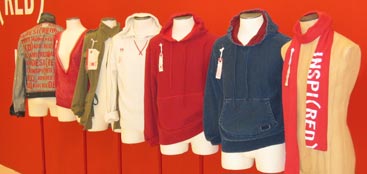
We have been tracking PRODUCT (RED) for some time here, here, here and here.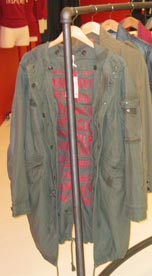 Coolhunting.com have gotten a preview (well aren't they special) of Gap's PRODUCT (RED), which launches in October. The clothing and accessories will be co-branded, and 50% of all profits from the sales of (RED) items will be given to The Global Fund to Fight AIDS, Tuberculosis and Malaria, the benefactor of funds (and media attention) of the PRODUCT (RED) movement.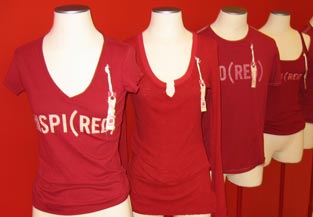
Gap's PRODUCT (RED) for Holiday 2006 includes tees, hoodies in cotton and in cashmere, jackets, jeans, bags, belts, caps, scarves, a bracelet, candle and Individuals, a book of celebrity portraits taken over the years by Gap (100% of sales from the book will be donated to the Global Fund). Prices will range from $10 to $350. Some PRODUCT (RED) tees are currently available in the U.K. The full line will be carried in flagship/key stores in the U.S. and U.K. starting in October (limited items in other stores), and will also be available online.
via Coolhunting.com
Thursday, August 17, 2006
Trend: Conscious Consumption: (Product)RED


Saturday, March 04, 2006
Trend: Conscious Consumption: (Product)RED
Bono and fellow activist Bobby Shriver have launched (Product)RED, a co-brand of cause-related products which put portions of your purchases towards doing a greater good beyond boosting shareholder value.
Per Bobby Shriver's comments on (Product)RED, "we came up with the idea of a brand that would create a sustainable flow of money to the Global Fund to help fight AIDS in Africa by tapping in to the world of commerce."
The concept is simple: buy (RED) and you get a product just as good as the competition while at the same time ensuring money gets to AIDS programmes in Africa. But really, you get an enviable fashion badge to display where your heart is.
Shriver goes on to state: "The equation of mutual self-interest is balanced and some may question it, but it’s time to get real. The traditional routes for giving are not sustainable over the long term and it’s time for big business to step up to the plate and see for themselves that doing good is good business."
(Product)RED has helped convince companies like American Express, Giorgio Armani, Gap and Converse to design and sell co-branded products, that as the name implies, will be colored red, that raise awareness and money for The Global Fund for AIDS, Tuberculosis and Malaria. Companies commit to contributing a percentage of sales, and the funds are used for AIDS-related programs for women and children in Africa.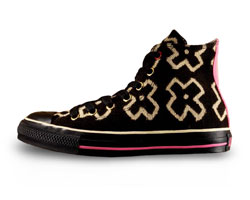 Join Red at http://www.joinred.com/
AKI COMMENT: From Livestrong, to Ethos Water, to Prius, to Goodwill, the New Do-Goodery has been gaining major ground as the "cool" thing to do.
I applaud the market-saavy and better-mouse-trappery that "cause" brands are increasingly adopting. How refreshing that causes are learning to stop begging and settling for chump change from the weekend brownie sale, and instead, are tapping the big money by speaking to consumers on the terms they can relate to: fashion, image, ego, reward, and commerce.
Some brands, like Goodwill, are sourcing new profits by SIMPLY PROVIDING A BETTER SERVICE. And ain't that cool for a change? Nothing so mystically "hip" here, just plain better organzed stores, better fixtures, and better displays. Equals more shoppers, and less embarrassed shoppers who now feel good about the stuff they bought. Good cause or not, these are the minimums we ask of any brand seeking to grab share of my wallet. And it is high time the "good guys" caught on to these realities.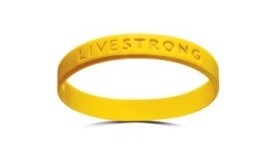 Obviously any fashionable "hot trend", like driving a hybrid or doning a Livestrong band, can just as quickly become "unhot" as too many people adopt the cool trend (nothing new for for-profit brands). But let's be real, most causes have the core objective of gaining awareness in a world of mental overload. Cool Fashion Do-Goodery at least makes a real measureable impact on culture (short-term or not). The fact that they have to start working harder to maintain or repeat the cool effect is, well, just the costs of doing business that we all face.
"Real" brands will soon have to wake up, as well as up-the-ante as the Do-Gooders get saavier, and cooler, and credibly hip. I'd expect more Do-Gooders to recruit more of the big brains in marketing and design and fashion, that were once exclusive to "real brands". And that is good for all. Do-Goodery is evolving past the unenviable lifestyle of confrontation, guilt and begging to a brand model that gains sustainable mass interest and commitment.
Monday, May 15, 2006
Trend: Conscious Consumption: (Product)RED vs. Moto
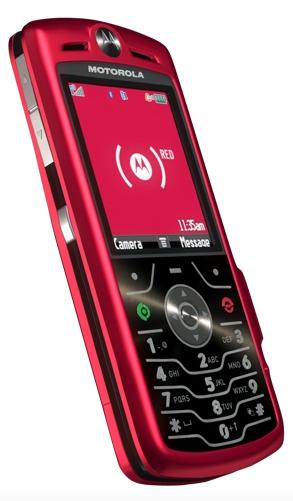
Motorola has joined U2 singer Bono's (Product)RED project and will start selling a red version of its Slvr mobile phone in the near future. A portion of revenue from sales of the red Slvr will go toward efforts to fight AIDS in developing countries.
The red Slvr won't likely provide a boost in sales for Motorola. "This will be a blip on the radar," said Ed Snyder, a stock analyst at Charter Equity Research. But the association with (Product)RED is certainly a positive development from a public-relations viewpoint. And a link with Bono can only help boost Motorola's quest to further position its brand as hip.
While Project Red has a philanthropic aim, Bono said in a recent interview with the BBC that the project is a commercial venture.
"Philanthropy is like hippy music, holding hands," he told the BBC. "This is more like punk rock, hip-hop, this should feel like hard commerce."
via Chicago Tribune
Wednesday, April 26, 2006
Trend: Conscious Consumption: (Product)RED Redux
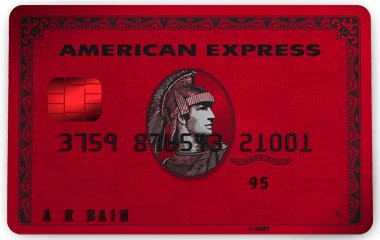
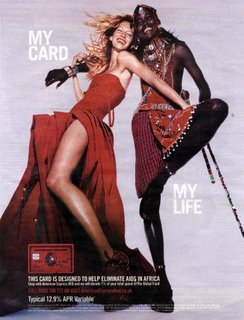
We posted over a month ago here about Bono's (Product)RED, a co-brand of cause-related products (including an Amex card) which put portions of your purchases towards doing a greater good beyond boosting shareholder value.
This fellow blogger at IdLand details some of the fine print:
Make no mistake about it, the donation is from you, not from American Express. Every credit card offer has some kind of deal where you get free things or money back, and a good way to choose a credit card is to calculate the exact percentage cash back that you are getting. For example, if you get one Air Mile for every dollar you spend, and it costs 25,000 Air Miles to buy a domestic flight in the United States (say, $400-500 max), then you're effectively getting between 1.6% and 2.0% off of your purchases. ($400/$25000)
Most credit cards offer effective discounts of 2-3%. The RED card gives 1-1.25% of your purchase value to the Global Fund, and there are no other discounts. Two things are eminently clear: (1) American Express is not hurting at all from this, as they are offering a lower implicit discount than that on their other cards; and (2) Your donation is real, since that 1% going to the Global Fund would eventually be cash in your pocket if you used any other card.
You are making a donation to the Global Fund every time you use the RED card. So why don't you get a receipt for a tax deductible charitable donation? Because American Express is getting it. Which makes the RED card little more than a way for American Express to get money out of you, foolish consumer.
An example should make it clear. Suppose you put $25,000 on your credit card in a given year. Should you use the RED card or should you use an Air Miles card and then give the savings to the Global Fund? Let's see what happens:
The Global Fund got a similar amount of money in each case - but using the American Express card has cost you the value of the tax refund!
See Red at http://www.joinred.com/ AKI COMMENT: While this is hardly the worst example of credit card consumer abuse, it is clever marketing, and cleverer math considering that Amex isn't even matching your donation or paying anything whatsoever to grease your consumption and use. AND still getting the tax credit and goodwill value, to boot! Brilliant, really.
As that great pimp/philosopher Bishop Don "Magic" Juan once said: "Don't hate the player, hate the game."
And Elle Macpherson looks very cute spending the very first Amex Red pound at Harvey Nichols! Her shirt reads "Empower(red)". Life is funny sometimes.
Saturday, October 28, 2006
Conscious Consumption: (Product)RED Rising

 The (Product)RED train just keeps on a chuggin' since last time we checked */
**/
*** iPod Nano Red, MySpace Red, Flickr Red
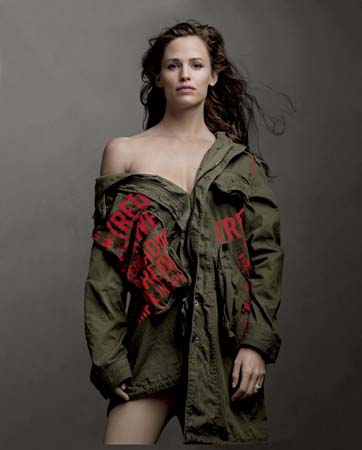 Gap Red has lined up the requisite list of celebs for its ad campaign: Chris Rock, Dakota Fanning, Jennifer Garner, Penelope Cruz, Steven Spielberg, Don Cheadle, and Mary J. Blige.
  While I have obtained no empirical data, Amex Red seems to be gaining in popularity and sentiment.
Monday, March 05, 2007
Conscious Consumption: (Product)Red Results Redux
 Ad Age says, "the tally raised worldwide is $18 million."
Yoinks!
The disproportionate ratio between the marketing outlay and the money raised is drawing concern among nonprofit watchdogs, cause-marketing experts and even executives in the ad business. It threatens to spur a backlash, not just against the Red campaign -- which ambitiously set out to change the cause-marketing model by allowing partners to profit from charity -- but also for the brands involved.
By any measure, the buzz has been extraordinary and the collective marketing outlay by Gap, Apple and Motorola has been enormous, with some estimates as high as $100 million. Gap alone spent $7.8 million of its $58 million outlay on Red during last year's fourth quarter, according to Nielsen Media Research's Nielsen Adviews.
"Red has done as much as we could have hoped for in the short time it has been up and running," says Rajesh Anandan, the Global Fund's head of private-sector partnerships, adding: "The launch cost of this kind of campaign is going to be hugely frontloaded. It's a very costly exercise."
Julie Cordua, VP-marketing at Red and a former Motorola marketing exec and director-buzz marketing at Helio, said the outlay by the program's partners must be understood within the context of the campaign's goal: sustainability. "It's not a charity program of them writing a one-time check. It has to make good business sense for the company so the money will continue to flow to the Global Fund over time." She added that since many of Red's partners haven't closed their books yet on 2006, more funds likely will be added to the $18 million.
AKI COMMENT: Despite the hatitude, Bono recently accepted his Honorary Soul Brotha Award from the NAACP. Below is his strangely moving and inspiring speech. The man just may be untouchable, ya'll.
+
Tuesday, May 16, 2006
Trend: Conscious Consumption: (Product)RED Propaganda

Bono Edits UK Newspaper
Today's edition of the British newspaper, The Independent, is edited by rock star and social activist Bono, with a cover designed by Damian Hirst.
The featured headline: "No News Today." In small type at the bottom of the cover, Bono elaborates, "Just 6,500 Africans died today as the result of a treatable, preventable disease (HIV/AIDS)."
Half the proceeds from the special edition will be donated to Bono's(Product)RED campaign, a world-wide branding effort to fight AIDS in Africa.
In an editorial, Bono writes, "I am as sick of messianic rock stars as the next man, woman and child. I am also tired of average work being given extra weight because it's attached to something with real gravitas, like the Aids emergency." But Bono is undeterred: "Right now, people you will never meet, who will never be able to thank you, are depending on you for the life-saving drugs which buying this paper will buy. For those people, my motivation or our (RED) motivation is irrelevant."
Monday, February 26, 2007
Conscious Consumption: (Product)Red Results
 According to Financial Times, after a first year of hype and hoopla (sure, even I joined in), the first Red-donated money has started flowing to Africa — $5.25 million has gone to Rwanda and $4 million to Swaziland — to treat HIV-positive Africans and to provide care for AIDS orphans. The fund has put 800,000 people in the developing world on antiretroviral drugs and is aiming to at least double that this year.
Eh. Not that I want to hate on a good cause. But this cash contribution seems a wee-bit short on true effectiveness when you consider product development, advertising, manufacturing, retail distribution, packaging, point-of-purchase displays... All the partners could have simply written a clean check to the cause and skipped the talking about it. Perhaps we'll give it some (more) time to build steam...
Saturday, February 07, 2009
New York Times' Interactive Graphs
On the day Barack Obama was elected President, the New York Times introduced an interactive poll they called the “Word Train.” It asked one simple question: What one word describes your current state of mind? Readers could enter an adjective or select from a menu of options. They could specify whether they supported McCain or Obama. The results appeared in six rows of adjectives, scrolling left to right, coded red or blue, and descending in font size. The larger the word, the more people felt that way. Throughout the entire day a river of emotions flowed through the chart. You could click from Obama to McCain and watch the letters shift gradually from blue to red, the mood change from energized, proud, and overwhelmed to horrified, ambivalent, disgusted, and numb.
http://www.nytimes.com/interactive/2008/11/04/us/politics/20081104_ELECTION_WORDTRAIN.html?scp=1&sq=what%20one%20word%20describes&st=cse
Recently, the New York Times created another interactive feature that harvested all Twitter chatter surrounding the Super Bowl. By pressing play on this graph, the reader is able to watch the location and frequency of commonly used words during the Super Bowl. In all, there are six different categories to choose from including, “Talking about Ads.”
http://www.nytimes.com/interactive/2009/02/02/sports/20090202_superbowl_twitter.html
These features have proven to pull readers closer through comments and interactivity, rendering the relationship between reporter and audience more intimate, immediate, and exposed. Of the massive 20 million unique visitors per month compared with the daily print edition’s readership of 2.8 million, the readers are flocking to these interactive features. As Jonathan Landman, deputy managing editor puts it, “We’re trying very hard to protect it [the interactive features], because that’s where the action is.”
For an advertising or marketing agency the implications for these interactive maps/graphs are big. The ability to get real-time answers about our products or services has existed for sometime now; think twitter, online forums, live chat…but not in this way. These interactive graphs create an entertainment value and coolness factor for the user while generating a visually appealing way to aggregate all their messages, emotions, or displeasure's about a brand, product, or service and communicate it back to the client in a simple way.
Here are links to some others:
http://www.nytimes.com/interactive/2009/02/02/business/media/20090202-business-superbowlads.html
http://www.nytimes.com/interactive/2008/08/04/sports/olympics/20080804_MEDALCOUNT_MAP.html?scp=6&sq=interactive&st=cse
And the link to the article about the people who create these graphs:
http://nymag.com/news/features/all-new/53344/index1.html
Tuesday, April 11, 2006
Trend: Outsourcing: McD's Drive Thru Call Center


I am not sure that most Americans fully understand the impacts of globalization on local market production.
McDonald's is experimenting with Drive-Thru service that outsources the order taking to a 40-person call center in Santa Maria, CA then sends the order back to the local restaurant.
No more local teen employment, and another strike at the economic stability of the working poor and middle classes.
According to a feature in NY Times:
The people behind this setup expect it to save just a few seconds on each order. But that can add up to extra sales over the course of a busy day at the drive-through.
While the call-center idea is in place at over 40 locations throughout the US, and has received some attention since a franchises began testing it 18 months ago, most customers are still in the dark.
The new service, currently experimental, reduces costs by centralizing customer service operations within a set of skilled and more precisely trained individuals.
The remote customer service center is subject to typical efficiency pressures. "Software tracks [their] productivity and speed, and every so often a red box pops up on [their] screen to test whether [they are] paying attention. [They are] expected to click on it within 1.75 seconds. In the break room, a computer screen lets employees know just how many minutes have elapsed since they left their workstations. During peak times, operators can take anywhere up to 95 orders an hour.
Money saved through this cost efficacy can be re-directed towards other facets of customer service and superior product innovation, like...hmn. Um. Well.
McDonald's is joined by the owner of Hardee's and Carl's Jr., CKE Restaurants, which plans to deploy a similar system later this year in restaurants in California.
And for the operators, another bonus. One worker said after work, "I don't smell like hamburgers."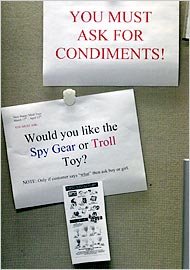
AKI COMMENT: Ironically, the current McD's commercial campaign features celebs like Carl Lewis and Macy Gray thanking McD's for their first jobs when they were kids.


 Seed Newsvine





