
Small Worlds is in open beta, come check me out. I can say that the startup process is easier than Second Life...I created my avatar and dog avatar in mere minutes. The interface, so far, seems a bit more gamelike than 2L, so navigation and activities are just clearer and more accessible.
So far, the clubs seem less like sex dungeons, again with a key on accessibility Small Worlds is pool halls and game rooms that get you into traditional games mentality. And finding them and getting there is easier than 2L. Music soundtracks play in most spaces and the selections are actually not bad (ie, real tracks from artists you've heard of and like, from Aphex Twin to Michael Jackson - don't know how ASCAP rights play out in Small Worlds).
Showing posts with label Postcards from Second Life. Show all posts
Showing posts with label Postcards from Second Life. Show all posts
Monday, June 16, 2008
Virtuality: Postcards from Small Worlds


Tuesday, September 25, 2007
Virtuality: Google Planning to Launch "My World"
Ars Technica (Art of Technology blog) reports that Google is prepping it's own entry into the field of Virtual Worlds, potentially named "My World". Students at ASU (a school Google has a strong working relationship with in the past) this weekend received questionnaires that "hinted strongly" at the possibility that they would be among the first to test such an app later this year.
(Screengrab of the questionnaire courtesy of the MacRumors forum).
A logical step for Google, given that they've already made a foray into Virtuality with Google Earth.
A few snippets from the article:
"The notion that Google might test the new service with ASU students isn't very outlandish, then, so the question is more a matter of what the service will be rather than if it will come to fruition."
"To us, it seems that a virtual world is natural progression of Google Earth and its 3D representations of... well, the Earth. Users could create avatars, like those in Second Life. The "street view" feature of Google Maps could be incorporated, as well as Google SketchUp, with avatars being able to walk around on actual streets and enter real buildings to check out what's inside and socialize with other avatars. But the purpose wouldn't be to rival Second Life and all of its fantasy, sex, and moneymaking schemes."
"Whatever "My World" ends up being, we think that Google will go much further than just competing with Second Life—if the company makes it functionally useful and ties it in with services that people already use, it may have a chance of succeeding at getting average Internet users to participate."


Monday, September 24, 2007
Virtuality: Social Media in 3D


I just came across this (thanks Aki) and while interested, still haven't quite decided where I see this going and how "big" it may be. Any readers out there more familiar and care to weigh in? For those of you in virtual worlds, do you see yourself social networking your virtual identities? Are you so dedicated that, in addition to maintaining Facebook, MySpace, and your other real world social webs that you would start a virtual side?


Friday, July 27, 2007
Postcards from Second Life: Metaverse
Derek Lerner at GHAVA shot a film on a NOKIA N93 to film video feedback loops "creating abstract video drawings as a metaphor for 3D immersive virtual space. Infinite syndicated regurgitated communicative white noise evoking feelings of becoming so intertwined with digital communications that the grayness of life as we currently know it is a blurry place of virtual and real."
See some of his Flickr photos of the work here
He further explains the work:
"For the last year I have been heavily involved in virtual worlds, primarily Second Life. This has prompted many thoughts about the concept of virtual space in general as well as blurring lines between simulation and real.
Mixing of realities, infinite space, multi-user online 3D collaborative environments, and time travel.
When asked to contribute work to the NOKIA Trends Lab project I immediately started to think about the level of connectivity and immersive experience handheld wireless hybridized multifunction devices offer, resulting in a type of virtual space. The sense I get when walking down the street taking photos, listening to the radio, & then uploading images to a server is of a disjointed reality where one's mind is in another place but body is walking down the street."
Postcards from Second Life: Virtual Recruiting Gets Hot
While many are likely to keep pouring on more haterade (such as here and here) and proclaim virtual worlds to be little more than a fad, many companies are finding that one of the more practical applications for them are as a good tool for recruiting. Check the CNBC segment on it here (short ad at the beginning).
It's interesting, while I can understand all of the skepticism around virtual worlds, I'm surprised more people don't acknowledge the similarities to mass reactions to the Internet in the 90's. Look at how far the internet has come in 10 years: in 1995, did anyone (besides perhaps the most techie guys out there) envision a future internet of MySpace, Facebook, YouTube, blogs, podcasts, etc and the tremendous impact all of these have on our lives?
Personally I don't think it's unrealistic to picture a similar path as virtual worlds become more user-friendly, visible exposure makes them less weird/freaky to the masses, brands learn how to actually do something of value instead of putting up buildings for no reason (and in particular, how to make it easy for people to get started and comfortable in-world ), and we all become more savvy at finding ways for them to provide value in our own lives.

Friday, June 29, 2007
Pollution Penance: Adventure Ecology Floods Second Life
I'm late to this, but seems organization Adventure Ecology (in conjunction with Ogilvy UK) subjected London, Amsterdam, Ibiza, Tokyo and other regions in Second Life to a sudden flash flood which thankfully lasted for only a few hours. The flooding of the areas was done to show the financial, and more importantly, environmental implications of global warming. David de Rothschild, a London-based environmentalist and founder of Adventure Ecology, spoke about the event saying that "Our message was, you may have a second life, but [you still need to] offset your second life in real life."
via MMORPG Blog and GreenNormal"
Wednesday, June 27, 2007
Postcards from Second Life: Crayon's Virtual Branding Event
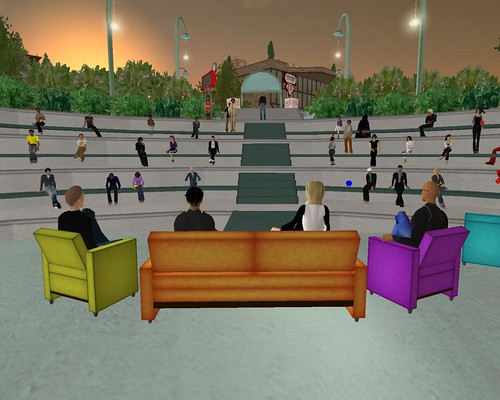
Yesterday, a few of us gathered around my computer and watched as my avatar made his way through SL to the Crayonville Amphitheater- virtual home to new marketing firm Crayon which was hosting a panel on Marketing in Virtual Worlds.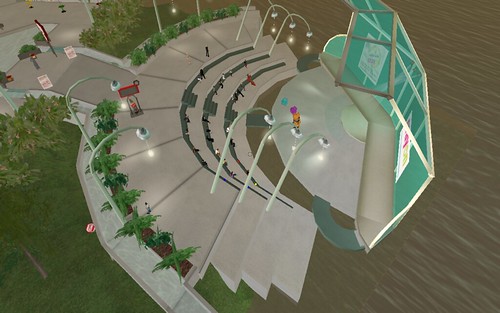

...towards brands/companies that view Second Life for what it is: a tool used to ENGAGE people. Coldwell Banker is a recent example of a company that gets the need to provide value to be relevant. Other (relative) success stories include Pontiac's Motorati Island, HBO's island for the L-Word (which holds recreations of the show in it's lobby), and IBM (company island includes tutorials on open source coding). These three have some of the highest weekly unique visitors in SL among real world brands (+4000 according to SL demographic experts).
Despite these few exceptions, it's not a surprise that the most trafficked areas in SL are those created by residents- they offer more than a slick logo and building, and bring some value to the table and the experience of being in-world (such as Amsterdam Island, a recreation of the real thing...complete with many familiar Amsterdam activities).
The panel discussion appeared to be one of those places residents respected as adding to the experience and not just "being there"...
Well, it's not bursting at the seams, but compared to the largely empty buildings of most companies, this is pretty good. And, according to Crayon, the sim was at max capacity and they actually had to turn away some last-minute sign ups.
Perhaps just as interesting as the panel itself was watching how the audience of avatars engaged with the presenters. While one might assume that, in this world where the laws of physics can be broken, and one has the ability to create objects from nothing, keeping people's attention would be tough. But there we all sat, pointed at the stage, listening intently to the words of these virtual branding experts.
We also started to see how closely this virtual world can mirror the experience of First Life. Just as you would lean over to a friend who was at a conference with you, whispering side-conversation back and forth, avatars were doing the same. (In Second Life, you can chat with basically anyone within earshot- simply start typing, hit send, and your words appear on screen for all to see. Think chatroom- with a visual component).
As we sat in our Minneapolis conference room, discussing the panel's comments, many of the same comments were popping up on screen from the avatars in attendance- some questioning the need or use for Second Life, and many other's pouncing quickly in defense of the world. The general consensus from the audience was that, while SL is important and shouldn't be ignored, it is still too complex, too vague, and not user-friendly enough for adoption by the masses.
Overall, a good event to take in. It was the first in what will be a monthly thought-leadership series. They also have weekly informal chats- Coffee with Crayon- every Thursday @ 9AM EST at Crayonville for more new marketing goodies.


Tuesday, June 05, 2007
Postcards from Second Life: Alternate Virtual Worlds
Found this great compile of alternate virtual worlds.
AlphaWorld - “SW City Revolution”:
From the website:
AlphaWorld, is the oldest collaborative virtual world on the Internet, and home to millions of people from all over the world. Since it’s birth in 1995 AlphaWorld has rapidly grown in size and is roughly as large as the state of California, and now exceeds 60 million virtual objects!
This has been open since 1996
Entropia Universe (aka “Project Entropia”)
The Sims Online - “”Sims Online” - game commercial”
PlayStation Home - “GDC ‘07: Playstation Home Debut Trailer”
Sony has officially and vehemently disqualified PlayStation Home as an alternative to Second Life. Here’s a quote from a recent Phil Harrison interview on the flog:
PH: I think you’re way oversimplifying by suggesting Second Life and Home are the same. In Home, you get a character and a 3D world, and that’s where the similarity ends. Second Life does some brilliant things but with Home, we’re providing a service. Therefore, the tone of voice is what will differentiate it – Home is about entertainment, it has a game focus, and it’s about sharing with a like-minded community. We don’t give users the level of influence over the environment, behaviour and object definitions that Second Life does – it’s as secure as any other PS3 game. With some of the operating system protocols that are built into the Cell chip, it’s about as secure as you can be on a consumer device.
Kaneva - “Kaneva - A Worldly Vision”
There - There.com First Virtual Steps
HiPiHi - “hipihi Newest test video frequency”
There’s no Chinese port of Second Life, but somebody decided to build something just like it. (The claim here is that they didn’t even know about SL when they started.)
Pre-Beta
Areae Inc. - They’re being very secretive, but seem determined to create a space that marries Web 2.0 (social networking sites like MySpace and YouTube) with immersive user-created environments like Second Life. They have an all-star cast of advisers, but so far we know very little else.
Outback Online - Promises to be just like SL but also with multiple planets.
-
Other Neat Worlds
Whyville - A 2D world for 8-15 year olds. It’s been around since 1999 as a safe and educational social environment. Players interact in environments where they learn about science, math, art, civics, and economics.
Cyworld - A huge hit in South Korea and a newer phenomenon in the west.
Check out this quote from Wikipedia:
Korea’s Internet culture has embraced the Cyworld model, which differs from the blog culture of the United States. The simplicity of buying items to decorate one’s minihompy, without needing to learn HTML or Photoshop, has attracted many young women who had not previously used the Internet. This item-based business model has also bolstered Internet community sites that had previously struggled as free services. Many renowned Korean socialites and celebrities have been known to possess a cyworld account in which details of their upcoming tours and works are posted, such is the case with korean icons such as Duk-In Joo, poet and author of the bestselling meaning of meanings novel.
The corporate world has also embraced Cyworld, with examples of companies creating minihompies to accompany product launches. Celebrities and politicians have also increasingly opted for minihompies, rather than homepages, to gain closer contact with the population.
Worlds.com - A collection of themed worlds commercially created. Free to play (although there is a premium account option), insanely low system requirements, and lots of music-band themed worlds.
See Habbo Hotel, Webkinz and Club Penguin for three more fun and monstrously popular social spaces… but I’ve got to stop somewhere here.
-
via Second Life Games Blog
Tuesday, May 15, 2007
Postcards from Second Life: World of Warcraft Visa
 Visa teamed up with Blizzard Entertainment, the makers of World of Warcraft, to offer a credit card that rewards WoW players with playtime if they make a qualifying purchase: "for each $1 spent on their WOW Visas, players will get $0.01 credit toward their $14.99 monthly subscription fee".
Good news, because it bodes well that WuTang Financial still has a chance of getting launched, too!
via GameSpot
Wednesday, May 02, 2007
Tuesday, April 17, 2007
Brave New Media: Evolution of Games
I was asked by a few here to give a "tour" of Second Life. I pulled out an insert from Wired magazine and we went to some of the better known 2L ventures. The recurring comment was "where are the people"? All these corporate constructs, but no people. Our visit to a sex dungeon revealed the people on a Monday afternoon and points to where all the real action is on the burgeoning 2L...Today.
The experience reminded me of 1994 when I went to the internet and looked up some random sites to visit. I had an insert from Wired magazine then, too, to guide me to the better sites. And I wandered into some chat rooms and sex dungeons to check out where the real action was on the burgeoning world wide web. Most of the sites I visited then were lame and not much use at all. However, users created eBays and Amazons and Netscapes and Googles and YouTubes to channel all that potential into profitable ventures beyond banal twittering.
If you impose Second Life onto this familiar framing of the 'evolution of games', the possibilities become clear. Or rather, the usefulness of Second Life is still not so clear, but the potential for users to eventually create previously unfathomable, yet fiercely ubiquitous uses becomes very clear.
Second Life, for the moment, is analogous to the internet circa 1995, or gaming circa 1974. Now: a banal waste of time, crude and choppy...tomorrow: perhaps a daily standard for us all.
Wednesday, April 04, 2007
Postcards From Second Life: Coldwell Banker, The First Real Estate Firm "In-World"

Rather, the plan is to drive sales of real estate in the real world. Hoping to use SL as a means to understand this "new consumer", actively engaged in social media, virtual worlds, and interacting with brands and each other in ways most marketers are still struggling (and often failing) to understand.
The Coldwell offices will be staffed with "real people" there to answer questions-- and, the company hopes, offset the lonliness may SLers feel wandering aimlessly in the often baren virtual world. Additionally, the company hopes to bring some order to real estate sale, currently controlled by random barrons who buy/sell and operate much like a black market.
It's an interesting play to me. Recently it seems we're seeing more and more companies taking some time to think about how they will actually add value in SL beyond just having a physical presence.
I decided to visit the offices, and see what Coldwell's deal really was.

Just like you'd expect in real life, I was immediately approached by a sales agents avatar, and for the next few minutes he proceeded to rattle off the services offered up in SL.
I found out I had to be of "qualifying age" (30-150 days as a SL resident), along with certain amounts of virtual currency (sadly I'm still clinging to the $250 Linden I got for signing up). There are "kiosks" set up around the HQ, and the units that are white mean they're available for sale/rent.
Actually quite the unique setup and an interesting idea, I was impressed at how well done it is. Not that I'm going to be forking up my real world dough anytime soon for a SL house, but I'll stand by and praise the move.
Whether or not this translates into people running to Coldwell for the real-life property needs, its interesting to see the company admit that this is just as much an experiment in learning how to approach/sell to the people in today's new media world as it is an exercise in making $$. I'd venture to say this is probably one of the smartest ways any big company has entered and set up shop in SL. There's clear value they bring (order to the land buying process), value in it for them (find out how to sell to people who are not buying a house because of a :60 TV spot), and translate those learnings back to real life.
Monday, February 05, 2007
Postcards from Second Life: Legality of Virtual Sales
 I was just noting the other day about the virtual gold in them thar hills in Second Life and the opportunities it may present for payment systems.
Shankar Gupta of Gaming Online/MediaPost, reports on various legal issues that plague virtual sales:
Online auction house eBay banned the sale of "virtual goods" such as currency or avatars used by players in massively multiplayer online games like "World of Warcraft," "Everquest," and "Neopets." Exempted from eBay's ban is sale of virtual goods+services of Second Life property, meaning that islands, housing or fursuits can continue to be sold on this, and other, secondary markets.
eBay spokesman Hani Durzy said the move stemmed from growing legal concerns surrounding the sale of virtual property. "Because of those legal complexities, we felt the most prudent thing to do at this point was to ban them from sale for the site," he said.
The taxability of online assets also remains unresolved. In October, the congressional Joint Economic Committee launched a probe investigating how virtual property and income should be taxed. Nearly every game's terms of service state explicitly that all in-game property is actually the property of the game developer or publisher, and not the player in question.
EBay likely could have put off this decision until the legal complexities were resolved and not come out any the worse for wear, but it is very, very likely that the company has been under pressure from game developers to end the secondary market for virtual goods. Why? Developers hate this market, especially when it creates entire companies (like here and here) dedicated to making money by "farming" virtual worlds for in-game cash and rare items. It's such a huge business that workers in Korea who spend hours a day doing nothing but farming virtual goods have attempted to form a trade union, claiming that virtual farming is a $1-billion-per-year industry.
MMO developers, obviously, don't see a cut of this money, and on a more fundamental level, secondary trading of items and currency can destroy a finely balanced virtual economy by causing massive inflation. Professional farmers spend hours collecting money and rare items. They can then put the rare items up for sale in-game, for in-game currency. Then, all the currency they've received is sold outside the game for real cash. Players then use the cash they buy to buy in-game goods, putting that virtual currency back into the pockets of the pros, who can then resell the currency out-of-game again. Over and over again.
Second Life gets a pass because it's not really a game -- it's a virtual world. Second Life has no game rules to speak of, other than the limitations of the platform and the rules set up on individual islands, and no goals, other than the goals that users set for themselves. And the process of people buying and selling virtual items in- and out-of-game is part of the appeal of the virtual world.
EBay's move to ban the sale of virtual goods is a boon for game developers, who recognize that buying and selling virtual goods online is the equivalent of offering your friend $50 for the Park Place card in a game of Monopoly. The exemption of Second Life helps draw a distinction between virtual worlds and simple online gaming.
Keep tabs on the economic state in 2L here
or read SL Business for the latest goings on.
via Gaming Insider and Online Media Daily
Friday, February 02, 2007
Cashless Society: Mobile Payment Meets Social Networking
It has been a minute since I have posted a Cashless Society update... Found this quiet and clever bit about OboPay, a US mobile payments company which has acquired BillMonk, a Website that helps people to keep track of the money they owe each other.
Seattle, Washington-based BillMonk's Website is aimed at social groups such as roommates who share bills, friends going on a trip together or dining out, or co-workers raising funds for a group present.
Obopay's acquisition of BillMonk means that BillMonk users can not only keep track of the money they owe each other, but also settle their bills using Obopay's text messaging service. They can use BillMonk to generate a running statement of exactly who owes what to whom. BillMonk users input their spending via text messages or directly onto the Website.
Oh, did I mention that BillMonk works seamlessly with/thru Facebook?
Obopay's payment service enables subscribers to send money to each other via mobile phone text messages. The recipient has to register at the Obopay Website to gain access to the money they have been sent.
An Obopay spokesperson says that BillMonk plans to support virtual currencies that are used in online worlds such as Second Life and World of Warcraft.
AKI RANT: I am beginning to feel vindicated about my crusade around here for getting in on the virtual cash economies (flashback and flashback).
Virtual gold is simply an untapped opportunity (stay tuned for updated $numbers i've dug up on this, soon). This is a no-brainer, services cost (from the fresh rims on my Grand Theft Auto to some "companionship" in the champagne rooms on 2L, to the designer sword for my ogre on World of Warcraft). Or if you don't like that, then you'll need increased branded sponsorship (Maybe free rims to all visitors at the Napa Parts Store on 2L? Free trial weoponry by Remington at the Cabela's on 2L? Free condoms from Durex on 2L?). Trust and security and exchange systems for money will be key in virtuality! OboPay+BillMonk are smellin' that pot o' e-gold over the rainbow.
 But let's check into more about this OboPay...
Obopay has signed up the first U.S wireless operator to support its mobile payment service. Service is now live on all Amp'd Mobile handsets. Amp'd Mobile phones all contain embedded Obopay application software.
Mobile phone users who have registered with Obopay's Website can send money via SMS text message to another mobile phone user. The recipient has to register at the Obopay Website to gain access to the money they have been sent. As an alternative to text messaging, a mobile phone user can use their handset's Web browser to send money to a third-party.
Obopay offers a stored-value account which comes with an Obopay-branded prepaid MasterCard debit card. Users can spend money in their Obopay account by using the card at ATMs or merchants which accept MasterCard. The prepaid card, which is issued by First Premier Bank, is linked in real-time to the Obopay stored-value account.
Los Angeles, California-based Amp'd operates a broadband wireless network that offers 3G voice and mobile entertainment services in the U.S. Obopay users can check their account balance and transaction history on their Amp'd mobile phone.
Initially, the main uses of Obopay are likely to be sharing money with friends, but the company envisages the service being used to pay merchants. Ultimately, Obopay wants to take advantage of Near-Field Communications (NFC) technology, which enables mobile phones to make contactless payments, a spokesperson says. Obopay last week signed a deal with VivoTech, the Santa Clara, California-based contactless card reader vendor, to allow Obopay users to access the ViVOwallet software to pay for purchases by waving their NFC phone at a VivoTech POS reader.
AKI RANT #2: The first rounds are fired for disintermediating banks and, in someways the traditional payment systems like Visa+Mastercard+Amex+Discover from the mobile payment sphere. At what point might the phone company provide me with all I really need to buy, sell and trade?
OboPay
BillMonk
via ePay News
Saturday, January 13, 2007
Politics 2.0: First Congressional Appearance in Second Life

 No, Katie Couric didn't report this one. [Eh - a pity that a multi-million dollar paycheck can't net us anything more interesting from Couric beyond retreading that dead 1950's formula. But I digress.]
Rocketboom's Joanne Colan conducted the first congressional appearance in Second Life last week with her interview of California Congressman George Miller.
(Note to SL makeup and wardrobe stylist: homie's highwater pants is a bit too tight in the rear! Nice hair, though. Believe me, girl, I know how much time it must have taken you to get that hairdo done right in 2L. Mmn, hmn. Ahem, but again, I digress.)
The event was fairly well attended (only one guy sleeping).
The congressman considers himself the proverbial "canary in the coalmine" with regard to future congressional involvement in 2L. Though he encourages increased collaboration and participation with 2L and other such media from his fellow congress members. 

Subscribe to:
Posts (Atom)


 Seed Newsvine


