Reader Slaven Marinovic, from Hamburg, Germany, submits to us his thoughts on the plethora of Agency-created magazines. He says, "Now that we all have become part-time fashion designers and/or musicians running our own independant label thing, it`s finally time to publish our own mags, of course with no corporate backing - strictly DIY."
While agency self-masterbation is not necessarily a new trend (this blog notwithstanding, of course), the act of investing efforts (and presumably costs) into self-published glossy style mags is. But is this good or bad?
I remember way back when Wallpaper magazine first dropped and won much envy and many a lucrative client for it's agency publisher Winkcreative. This was a new model, at the time, for building agency awareness and imaging itself as relevant and on the pulse of what's fresh...and presumably imparting great "qualifications" to handle your account.
I suppose another by-product of such efforts is releasing the tensions of pent-up creatives and writers who just sometimes want to get something done and out in front of people without client filters and caps.
Slaven further remarks, "Agency mags have obviously learned the Ogilvy lesson - publications attract clients - and are exposing their good (or poor) ideas/thinking/writing/taste by either taking the experimental 'let's have fun'-road or by issuing the hundredth lukewarm post-Wallpaper avantgarde lifestyle glossy.
But judge yourself, here are some links:
http://www.hekmag.com
http://www.verysuccessfulbrandmanager.com
http://www.ladestation.net
http://www.taped-mag.de
http://www.destructed.info
http://www.sfaustina.com
http://www.cobaltrevolter.com
http://www.twohundredby200.co.uk
http://www.castlemagazine.de
http://www.cuemix-magazine.com
http://www.candyculture.net
Thursday, October 12, 2006
Trend: Agency Magazines


Tuesday, October 10, 2006
New Media: Advergaming
AV: BusinessWeek reports on Burger King's newest advertising endeavor. In a partnership with X-Box, the chain will be releasing 3 games in order to promote its "advertising icons", particularly the (in)famous King. I've always found that character to be creepy as hell, particularly those spots where some unsuspecting dude wakes up in bed to find this CP+B creation staring back, gaping-mouth and all, with whatever new monstrosity Burger King had cooked up. Although, I have to admit, Big Buckin Chicken made me laugh, as did the odd yet surprisingly entertaining Subservient Chicken website...
Some excerpts from the article:
"Burger King is releasing three Xbox games based upon those commercial properties. Pocketbike Racer, Big Bumpin' and Sneak King cover a variety of casual game categories and will all retail for less than $5.
"While Burger King has been on the leading edge of marketing with things like the Subservient Chicken and a website where Darth Vader read your mind, they haven't been falling behind in the in-game ad sphere either. Even before these recently announced Xbox titles, the company launched an extensive campaign with EA Sports' Fight Night Round 3. The game featured extensive Burger King in-game ads, including The King as a trainer/sparring partner."

"Burger King had a conceptual desire to create a custom gaming experience for its consumers and after meeting with Xbox this idea quickly evolved," explained Hayes. "In the end, both companies shared the creative spark associated with developing and delivering a unique consumer entertainment experience."
"Burger King strives to reach consumers in unique and non-traditional ways," she continued. "This particular initiative is in response to consumers' growing interest and involvement in video games as entertainment and showcases Burger King's commitment to taking brand integration to a new level. It's also a great value for the money, which is a consistent theme with all of Burger King's products and promotions."
BW on the idea of "advergaming":"While the term "advergame" has only existed for a short while, advergames as a concept is not entirely new. They go back at least as far as Kool-Aid Man on the Atari 2600 and Intellivision. Other such games include Yo, Noid!, two games based upon the 7-UP Cool Spot and another two games based upon Chester Cheetah, among others."
"The most common use and application of advergames nowadays relates to mobile and casual titles. These games are often free, supported by the cost of their advertising nature. Still, Hayes asserted that advergame was an inadequate description for what Burger King was doing."
Monday, October 09, 2006

User-Created: Starwood Hotels Blog the Developer's Experience in Second Life
AV: Starwood Hotels, part of the W hotel empire, is slated to open the first virtual hotel within the Second Life world. They've been maintaining a blog about the experience from a developers standpoint...not necessarily the most riveting material, but, a novel idea either way. And being someone who knows virtually (bad pun intended) nothing about land development or software/virtual world development, I found it to be an interesting blog to browse now and then...

Preparing for Resident Activities
"One aspect of preparing a project for Second Life that we (ESC) try very hard to stress to our clients is the importance of planning past the grand opening festivities. What will keep people coming back to your island? This isn't a problem unique to real-life business builds in SL - maintaining a steady flow of visitors to your land, club or business is something that all residents tackle in their own ways."
"Shopping, games, and social activities are the biggest draws that keep people returning. The virtual aloft project team has a few fantastic ideas on the burner to that end, and one specific build on the island we hope to utilize repeatedly in the future is the outdoor stage."

A Virtual Photo Shoot

"I recently wrote about how the parallels between the virtual world and real world are often colliding on this project, to an extent that it becomes a bit strange and bizarre to experience."
Last night was another one of those experiences.
"Earlier in the week, we received a call from a terrific magazine who are currently putting together a story about the aloft project. While discussing what photographs would be available to run with the story, the decision was made that we would do a photo shoot for the magazine that would bring together all of the people involved in the project. Except rather than take the photograph at the real Starwood offices in White Plains, we decided to do it inside of Second Life at the virtual hotel."
"So at around 10pm last night all of the avatars representing the various teams from Starwood, ElectricArtists, and Electric Sheep congregated in front of the hotel for the photo shoot. Like in the real world, the sun was setting as we talked about the shot and thus we had to move quickly to get everyone in place before we lost our light. Also like in the real world, we even had people there to help with clothes and hair. For the photo, the photographer had us all look in the same direction at a red box in the sky. The whole experience was extremely bizarre and after a few minutes you forgot that you were on the computer and instead began to feel as if you were actually there watching a beautiful sun set as the photographer gave directions on where to stand and where to look."
Podcasting on aloft and Second Life

"BusinessWeek Online posted a 12-minute podcast I did with their correspondant Reena Jana. We discussed the challenges of bringing real world structures into a virtual world, both conceptually and technically; the benefits of Second Life for creating an iterative conversation with customers on issues like design; the appropriateness of certain products versus brands within virtual worlds; the hype versus promise of the Second Life platform; and the power of relationship building within virtual worlds."
I hope you find it interesting."
How To Teleport to the Island of aloft

"As we continue to build the aloft hotel inside of Second Life, we've started showing people what the actual island of aloft looks like."
"If you're currently a resident of Second Life, you can teleport to a neighboring sim called Argali. There you can peer in from the Argali border. You will need to raise your draw distances to see it. Draw distance (in the preferences, graphics tab) determines how far out objects "rez" i.e. show themselves. If you set your draw distance to 256 meters you should be able to get a good look at the hotel."
About the aloft hotels experience:
"aloft is a reinvention of the travel experience, an oasis where least expected – a spirited neighborhood outpost where uncomfortable cookie-cutter mediocrity is the norm and innovation a long forgotten luxury...until now."
"Bringing a cozy harmony of modern elements to an otherwise stale travel landscape, aloft offers more than just a place to sleep. It’s a unique social environment to relax and meet others…a place to unwind after a long day at work or on the road. Designed with natural materials and textures like cork and wood, with loft-inspired, 9 foot high guest rooms, state-of-the-art technology, modern amenities, and signature “r & r” beds, aloft is a sassy, refreshing, ultra-effortless alternative to the same-old, same-old, polyester and concrete hotel. It’s fresh, fun, and fulfilling…a place to be discovered and rediscovered…destination after destination."
Click here to go to the aloft hotels website
Politics 2.0: MySpace Registers Youth to Vote
While they may be a bit late-ish...there are still some weeks to motivate and engage.
MySpace launched a voter registration drive in partnership with nonpartisan group Declare Yourself by running ads and giving members tools such as “I Registered To Vote On MySpace” badges to post on their profile pages.
Members go to the Declare Yourself MySpace page to get their particular state’s registration form.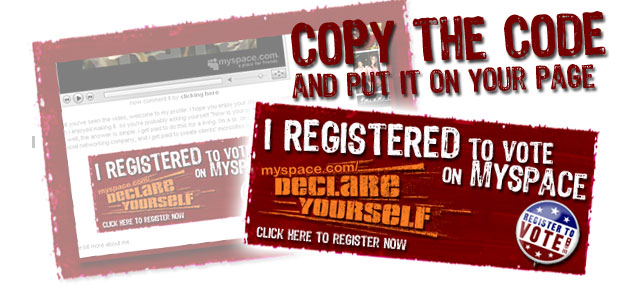
Friday, October 06, 2006
User-Created: Hip-Hop's "Unwelcome Attention" Continues
 Last I left this story Jay-Z, president of Def Jam Records, said f*@k Cristal, and joined the UN to promote water for the world's needy. Beyonce said f*@k sippin' the "Crissy" champagne backstage, Rihana, Lil' Kim...
Now Nas and Diddy got beef with Cristal.
Nas says he is in full support of a continued, formal boycott of Cristal--but only if Hip-Hop steps up to replace the champagne, which typically sells for $50-$600 per bottle. "I support a boycott if we could come up--like if we put up something, our own champagne. There's tons of vineyards we could get into and buy," Nas told AllHipHop.com in response to controversial comments made by Cristal's managing director against rappers who drink the beverage.
Both Nas and Sean "Diddy" Combs are gearing up for fourth quarter album releases.  In 1999, when Diddy lent his vocals to Nas' hit song "Hate Me Now," the pair brandished bottles of the pricey champagne in the Hype Williams-directed music video. Diddy told AllHipHop.com, "Cristal definitely caught us out there. It was a learning lesson. At the end of the day, f**k Cristal. They don't respect us."
via AllHipHop.com
To get back to the origin of hip-hop's Cristal war see here, here, here, and here.
And to reminicsce over those lost innocent days when hip hop was proud to "get pissy with da Crissy"
Mass Interactive: Over-35 Crowd Invades MySpace
 Ad Age reports: "Teen Membership Drops at MySpace as Over-35 Crowd Grows"
In August, the site's share of teens 12 to 17 dropped to 11.9% from 24.7% year over year, while internet users between the ages of 35 and 54 -- not exactly trendsetters -- now account for 40.6% of the MySpace visitor base, an 8.2% increase during the past year.
Teens crucial
Whether MySpace can survive without teens isn't clear. "Staying relevant and hot among teens is a really tough game, but if they lose their edge there, I think they're in trouble," said Allen Adamson of Landor Associates, a branding consultancy in New York. "While it's nice that they're picking up steam among older users, they're going to have a tough time if they lose young trendsetters."
Already peaked?
Older MySpace members tend to be less active in the community. This month, the average 12- to 17-year-old spent 260 minutes on MySpace and viewed about 808 pages. By contrast, the average 35- to 54-year-old spent 179 minutes on the site and took in 560 pages.
MySpace drew 79.6 million unique visitors in August, according to ComScore World Metrix, an impressive 243% increase year over year.
Pushing everything
News Corp. is using MySpace to push everything from movies and TV shows to soft drinks and mobile phones. Earlier this week, Fox loaded the site with already-aired episodes from the current season of "Bones," "Prison Break," "Standoff," "Vanished," "Justice," "Talk Show With Spike Feresten," "'Til Death" and "The Loop." Those shows are being supported initially by ads from Toyota, Burger King and Lions Gate Films.
Young-adult members of MySpace, 18- to-24-year-olds, dropped 1.4% to 18.1% from a 19.6% share. The block, made up of 25- to 34-year-olds, meanwhile, grew 6.2% from 10.4% to 16.7% of MySpace users.
Facebook, Xanga
Facebook.com, which began as a social-networking site for college students, is still drawing a younger audience, according to ComScore. More than a third of visitors to Facebook.com are 18 to 24, about three times the representation of that age segment in the general internet population.
A fifth of the social site Xanga.com is made up of 12- to 17-year-olds, about twice as high as that age segment's representation, according to ComScore. 
Thursday, October 05, 2006
New Media: Virtual Worlds as the Next Realm of Advertising?
AV: I've posted a few times here about big brands and agencies getting into Second Life. In a recent paper, Brand Channel discusses how SL, video games, and other 'virtual worlds' may be shaping up to be the next big thing in advertising.
"What do Major League Baseball, Coca-Cola, Wells Fargo, the W Hotel and the American Cancer Society all have in common? They all use a virtual realm to reach out to potential customers and supporters in novel ways. Today, traditional media captures less attention from the younger generation—including the young at heart! New venues that address this demographic are evolving." "One such approach to connect to this elusive audience is video game advertising. Consider Massive Corporation, which is now part of Microsoft. The premise of this organization is to reach "lost boys" (ages 18 to 34) who pay less attention to mainstream media. The advertising "spend" for this market segment is estimated at US$ 12 billion for television and another $10 million on static product placements in video games. The challenge for advertisers is a declining use of television due to other distractions (Internet, music, messaging) or simply "skipping" ads via TiVo or other recording devices. Another age-old problem for advertisers is the inability to directly measure results or return on investment (ROI)."
"Another untapped arena for advertisers is Virtual Worlds. Places like Second Life and Entropia Universe provide opportunities to interact and communicate with users in ways not achievable through traditional mediums. In these settings, individuals create a 3D "avatar" (human or fantasy characters) and through walking, flying or teleporting can explore unimaginable worlds. These virtual spaces take shape in numerous forms and may resemble a city street in Amsterdam, a walk through the Louvre in Paris, or standing on the bow of the Titanic—strike a pose as Rose or Jack! As part of your "second life," you may acquire land, build a house and shop at yard sales to buy clothes or home furnishings. Real dollars are exchanged in these worlds and the lines between fantasy and reality become blurred. In addition, you may form relationships with neighbors and groups that share similar interests or causes. Innovative organizations may create venues that interest this younger generation and weave their brand into the activity or environment."


"What is the real value of advertising in this new virtual world? First, consumers have the ability to experience things not currently possible in the real world. Product trials in virtual settings provide a low-risk environment for testing features and benefits. You can hire avatars to be product ambassadors and answer common questions. Also, you can demonstrate your 3D product or service in use. Live video and jpegs can add to the experience to help educate the user. In some cases, live feeds such as the Atlantis Shuttle launch can be viewed in some virtual settings."
"Could virtual environments be a just another channel for advertising or a viable community for consumerism? When blogging came on the scene, people dismissed it as a fad and characterized it was a soapbox for loonies! Today, organizations of all sizes closely monitor these sites and take what's being said very seriously. Could virtual worlds be the next medium for advertising?"
via brand channel
Mass Interactive: Wal-Mart Aborts Teen "Hub" Mission
 Less than three months after launching its quasi-social-networking site aimed at teens, Wal-Mart has shut down the Hub.
The homepage at schoolyourway.walmart.com/ now simply reads "Back to Class" and explains, "Sorry, but the School Your Way promotion has ended." After a few seconds, visitors are automatically redirected to Walmart.com.  "The Hub" was designed by Wal-Mart to allow teens to "express their individuality" but it screened all the content, informed parents when their kids joined and forbade users to e-mail one another. Teens were invited to create their own page so they could "show it to the world and win some fab prizes," including a chance to have their videos appear in a Wal-Mart TV commerical. Users complained the site was too promotional and had too many fake user profiles.
Wal-Mart launched the site to coincide with its back-to-school campaign in mid-July and to close the trend gap it faces with Target as it aims to win more teen-apparel dollars.
In August, the site attracted 91,000 unique visitors, according to ComScore Networks. Social-networking giant MySpace.com garnered 55.8 million unique visitors the same month.
via AdAge
AKI COMMENT: Air Force, Wal-Mart. To quote Pink Floyd: "Leave dem kids alone!". It is refreshing to see that the ecosystem of the web and social networking can withstand foreign invaders, right itself, and expunge the germs. And rather quickly, too. Trust Systems like EBay make it difficult for a sheister to conduct business for long. And social networks are proving the same is true for the awkward looking "cool" advertisers who look like your dad clad in shades spouting some out-of-context lingo and otherwise stinkin' up the party.
The problem with "hot" trends and movements like social networking is that everybody (advertisers and brands) assumes they should (and can) do it, too. Even when brand doesn't align with the tactic or particular party they're infringing on. The recent bandwagon wave of advertisers putting on sunglasses and posing in chat rooms (or in this case, trying to own the whole damn thing rather than try to humbly participate) is coming to some harsh ends, and the rightful players will succeed without the predators skulking about.
I will give Wal-Mart the point for TRYING SOMETHING. At least they are adopting an innovator's mindset of fast failure. Hopefully the lessons in technique have been learned. And hopefully they won't go the other route that big advertisers tend to take after such attempts (and failures) - which is to get mad and insist "this social internet thing is dead", solely because they didn't do it right.
Wednesday, October 04, 2006
Trend: Web 2.0
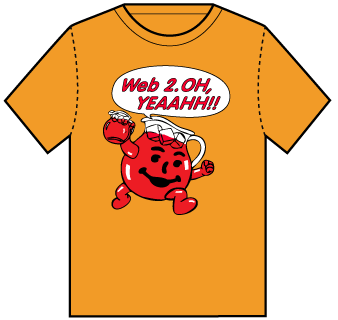
If you get the joke, then you've likely drank the spiked Kool-Aid...and you're a geek.
Order yours here
via ProductDose
How To...Make a Video Viral
 How to...Make a Video Viral
Two "Entertainment Weekly" writers consulted experts at CollegeHumor, YouTube, Google Video, AOL Video and MySpace this summer to find out what makes a viral video sensation. The keys to viral success, according to the amateur filmmakers, include:
* Comedy: The most successful consumer-created videos are funny and spontaneous.
* Hooks: Viewers must be drawn in within the first 10 to 15 seconds of video.
* Music: Sound adds to a video's entertainment value.
* Length: Short is always better.
* Relevance: Most viral sensations target a niche audience and include nostalgic or pop culture references. Then when you make it, chart it globally here
via womma.org
Tuesday, October 03, 2006

CrowdSourcing: Innovation Bounties
Stakes are high. And the bounties are getting higher for anyone with a better idea.
RBC Next Great Innovator Challenge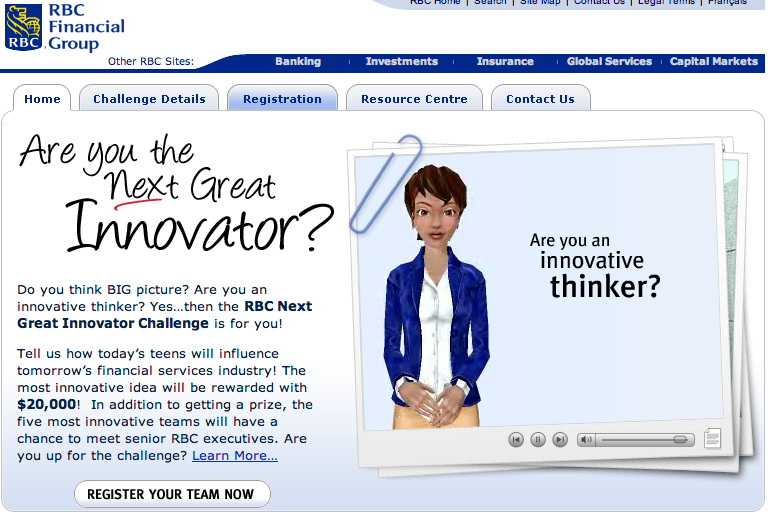
Realizing that some of the most important financial innovations of the next few years will probably derive from the teenage demographic, Royal Bank of Canada is sponsoring the Next Great Innovator Challenge for university students in Canada. The idea, it appears, is to get an early-mover advantage when it comes to new financial innovations for the consumer market while giving young students full rein to use their Web 2.0 know-how:
"This is your chance to stand out. Assemble a team of three to four university or college students and show everyone just how innovative you really are. The top five teams will each receive cash rewards and a chance to present their ideas to senior RBC executives... How will today’s teens influence the financial services industry in Canada? Describe an innovation, idea or concept that financial services should consider in light of this."
To give Canadian university students a running start, RBC has provided a list of questions to consider, encouraging teens to consider how the use of technology and new demographic trends are forever changing notions of loyalty and trust and forcing a reconsideration of the competitive landscape for financial services.
Netflix Innovation Prize
Inspired by some of the great innovation prize competitions in business history - like the 1714 Longitude Prize offered by the British government - Netflix has announced the creation of the $1 million Netflix Prize, which will be awarded to the first person to improve Netflix's movie recommendation system's accuracy by at least 10%:
"Netflix will make 100 million anonymous movie ratings ranging from one to five stars available to contestants. Currently, when renters watch recommended movies from Netflix, they rate them on average of a half star higher than the other movies they rent... The Netflix recommendation system uses proprietary algorithms to process the more than 2 million new ratings a day in order to pair users with patterns found in the over 1.5 billion ratings already noted.
But if a contestant can bump that half star up another 10 percent, Netflix will license the technology and publish a detailed description of the winning approach. If no one can meet that threshold, the company will annually award a $50,000 progress prize to whomever makes the most "significant advancement" toward that goal until someone does meet it. In order to avoid the scandal that sometimes accompanies the release of user data, Netflix has removed all personal information from the 100 million ratings, scrubbing them clean of everything but their dates."
For more on the Netflix Innovation Prize, check out the NPR interview with the VP of recommendation systems at Netflix.
via Fortune's Innovation Forum Blog
Lost Experience Interviews
 THE LOST EXPERIENCE: AUDIO INTERVIEW w Mike Benson, SVP of Marketing for ABC Entertainment
Rick Matheison at Generation Wow (and author of Branding Unbound), talks with Mike Benson, SVP of marketing for ABC Entertainment about how he convinced all those advertisers to pay to promote his show, what he learned from “The Lost Experience,” and his views on the power of multiplatform - "3D Chess", branded entertainment in promoting products - from content to consumer packaged goods - in the age of viral media.
HERE
In Part 2: The genesis of "The Lost Experience," and how ABC lined up key promotional partners to make it a reality.
HERE
In Part 3: Benson's thoughts on Mark Burnett's new Gold Rush initiative – and the power (and dangers of) integrated, multiplatform marketing.
HERE
In this Conclusion: What ABC learned from "The Lost Experience" – and what it might do differently next time.
HERE
Guilty Pleasure: Virtual Cassette

Make your own virtual cassette
Keep trading the tapes! Just enter some text and click the 'Go' button. A picture of a cassette will be generated for you. Collect 'em, trade 'em, put 'em on your website, or e-mail 'em to your friends.
Trend: Agencies Move into Second Life
Following in the footsteps of Leo Burnett, Bartle Bogle and Hegarty has announced that they will be getting into the SL mix.

According to the press release, “The BBH office will be a functioning office, with client meetings and new business presentations. Departments have planned activities across the building. The agency will be holding seminars with speakers from the agency. More broadly, BBH will be hosting forums with Second Lifers to discuss challenges and involve these digital advocates in new business problems. Avatars of BBH’s receptionists will be manning the front desk.”
The office will be located on an island sim currently being set up for BBH. While the press release boasts that BBH will be “the first advertising agency to open a virtual office within Second Life,” public relations and marketing concerns have preceded BBH, though this is certainly the first entrance of such a high-profile real-world ad outfit. It will be interesting to see just how BBH uses the platform, whether they market to avatars, leverage the platform for a real-world PR boost, do some futuristic branding or some combination of all those ideas and more."
via 3pointD.com
AV: BBH's move into SL seems to take a bit of a different approach than that of Leo Burnett. While the latter has described itself (and been described) as more of a 'community for worldwide agency creatives' to collaborate and function in the virtual world, the BBH effort is more in the vein of a full-out shop functioning just as its counterpart does here in reality. I suppose the move of agencies into SL is logical given that high power brands such as ADIDAS have staked their claim in the virtual territory.
I've posted a few times here on Second Life and the more I read about it the more intriguing I find it. The sheer scope of it is incredible, and the 'user-generated' world really has elevated SL to a level that other online communities, virtual worlds and the like don't really compare to. The big question now is what will be the impact on the bottom line? Sure this is great for exposure and a new way to connect in consumers lives, but is there a clear business result? I would think there has to be one, otherwise we wouldn't have traditional and patently risk-averse companies such as Wells Fargo diving into the fray...we'll have to see whether these are just high expectations that go unfulfilled or strategic business moves that produce solid results.
Conscious Consumption: Campbell's Pink Redux
 Breast Cancer Awareness Strategy Doubles Sales of Campbell's Soup
•Sold 7 million cans to Kroger for the crucial month of October when it normally sells the chain only 3.5 million cans
•Effort also has gotten Campbell incremental displays outside the soup aisle at Kroger
•"We certainly think there is the possibility of greater sales since our typical soup consumers are women and breast cancer is a cause they're concerned about," Campbell spokesman John Faulkner said.
•Kroger effort is a test of the popularity of the pink soup cans and Mr. Faulkner said he would "love to see the program expanded greatly next year" with other retail partners.
•According to a 2004 survey on cause marketing done by Boston brand-strategy firm Cone, 91% of 1,033 consumers say they have a more positive image of a company or product when it supports a cause and 90% will consider switching to another company if it's aligned with a cause.
•Breast cancer in particular has been an increasingly popular cause for marketers to align with. Campbell will donate $250,000, or roughly 3.5 cents per pink can, to the Susan G. Komen Foundation through Kroger in exchange for its doubled order.
•The potential payoff is big for the company, even after the donation is deducted.
via Ad Age
Monday, October 02, 2006
Culture: Wooster Collective @ Conflux
We Make Money, Not Art files a great report about Sara and Marc Schiller from Wooster Collective, who presented at the Conflux Festival in Brooklyn, NY.
The title of their talk was "What is it about street art that inspires us?" What inspires them has no particular set of rules nor well-defined criteria, it's an "emotional thing." The talk tried to break down the DNA of street art, without pretending to be a dogma or a text book, it's just the gathering of their thinking of two persons who've been following and documenting very closely the street art scene since 2001.
3 critical ingredients of street art:
1. Location, location, location!
It has to be illegal. A work of street art reclaims the public space and the best street art has a context, builds a relationship with its environment, dialogs with the city. Most of the artists document their work on the web. It doesn't mean that street art is meant to be seen on the web. The art has to be left in the street where it might stay for months or just half an hour. Most of the pieces are one-off.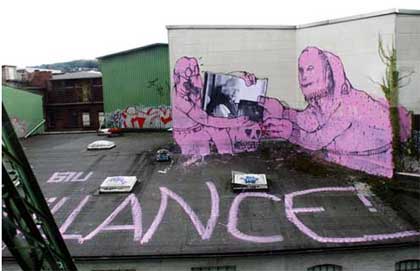
2. Surprise and delight
The works tap into our emotions and we get that WTF ??? moment. The web cannot recreate that experience but it's still important to document the works on the internet because not everybody gets the opportunity to see one of Banksy's works. Besides, half of the passersby might walk by the work and totally ignore it. Creating surprise and delight doesn't require a particular skill or training, it's more a matter of ingenuity and brillance.
Above, the "Crate Man" in Melbourne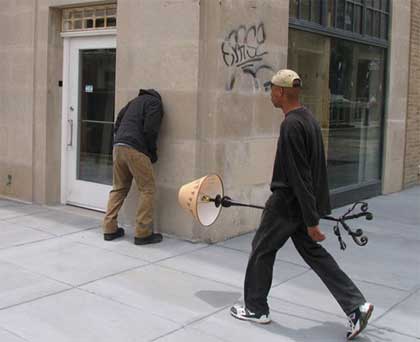
"Embeds" series by tape artist Mark Jenkins.
3. Have something to say
A statement on how you see the world, the best pieces do not necessarily make a strong political statement but they will make you see the city under a different light. Artists let passersby make their own interpretation of the work. Half the people pass by and might never see it though.
A knitted, pink cosy for a tank of the Danish Army. Knitted by Marianne Joergensen plus some 1000 volunteers
4. Personal and intimate
The pieces are very subjective. It takes time, commitment and money to craft works (most of the pices are hand-made and one-offs) that might disappear nearly as soon as they have been left in public space, street art can therefore hardly be regarded as vandalism. Once you leave a piece in the streets, you don't own it any more and have no control over it, it belongs to the street. Besides all the pieces change over time, because of the elements and the weather. 
Little bees in a backyard in Amsterdam.
Culture: Banksy Punks Paris Hilton
 Hundreds of Paris Hilton albums have been tampered with in the latest stunt by "guerrilla artist" Banksy.
Banksy has replaced Hilton's CD with his own remixes and given them titles such as "Why am I Famous?", "What Have I Done?" and "What Am I For?"
He has also changed pictures of her on the CD sleeve to show the US socialite topless and with a dog's head.
A spokeswoman for Banksy said he had doctored 500 copies of her debut album Paris in 48 record shops across the UK.
She told the BBC News website: "He switched the CDs in store, so he took the old ones out and put his version in."
But he left the original barcode so people could buy the CD without realising it had been interfered with.
Banksy is an grafiti artist notorious for his secretive and subversive stunts such as sneaking doctored versions of classic paintings into major art galleries.
The following posting on YouTube shows you how the kaper was done...not that I suggest you should go out and do such subversion, too.
No customers had complained or returned a doctored version.
via BBC
Culture: Footworkin'
The Chicago Tribune has a great feature on footworkin', a dance form created in (and largely indigenous to) Chicago's south side. Four good videos worth checking out. Sorry, can't embed them; here's a YouTube example for instant gratification:
Even though footworkin' is now getting covered in mass media, it's still far behind krumping (made famous by the 2005 documentary Rize). And since I haven't witnessed krumping at any Fallon fiestas, we may have to adjust our 9 month Brinker culture curve before predicting exactly when we'll see Adrian (let alone Greg) kill some raw beats. In the meantime, another example:
And for those I lost at "krumping," a demonstration:
via Chicago Tribune
Whatever happened to creative advertising?

Whatever happened to creative advertising?
Miami Herald considers the enthusiasm for risk-taking has declined in recent years, resulting from massive consolidation of the advertising industry and the emphasis on cost cutting.
An excerpt from the article:
To break out of this rut, the chief executive of Procter & Gamble, the nation's biggest advertiser, recently decided to shift some of its business away from Saatchi & Saatchi to Weiden + Kennedy, Nike's longtime agency, known for its creativity. But Buz Sawyer, who runs Weiden's office in New York, said it took P&G six months to identify a brand manager within the company who was willing to work with an edgy agency that relied on gut instinct rather than focus groups to create ads for Old Spice.
Any connections as we're promoting "Juicing the Orange--How to turn creativity into a powerful business advantage?"
1st Annual Northland Bioneers Conference
 What is Bioneers? Bioneers is a forum for connecting the environment, health, social justice, and spirit within a broad progressive framework.
http://www.bioneers.org
http://www.nbconference.org/
This October, an exciting new gathering is coming to Minnesota. The 1st Annual Northland Bioneers Conference presents an interactive forum focused on solutions to our most pressing environmental and social issues. Hosted by Northland Sustainable Solutions, a newly formed non-profit organization, this three-day event is expected to draw over 750+ participants from the surrounding five-state region to Minneapolis Community and Technical College, where it will be held. The Northland Bioneers Conference will include interactive workshops with local experts connecting the environment, health, social justice, and spirit within a broad holistic framework. There will also be exhibits, films, art and entertainment. In addition, a portion of the program each day will feature a satellite broadcast of 15 plenary sessions from the national Bioneers Conference, held in San Rafael, California. For 17 years, Bioneers has been headlining the world's leading thinkers in connecting the dots between the environment, health, science, social justice and spirit.
This conference will be a wonderful opportunity to hear both national and local presenters who are on the cutting edge of environmental and social innovation. Imagine buildings that generate more energy than they consume, factories whose waste water is clean enough to drink and plastics that can be turned into soil at the end of their useful life. Hear from local college students growing food for their own cafeterias, learn what small groups all over the world are doing to protect water rights, and hear from innovative local businesses who are energy independent. This conference is solutions based and conference attendees are filled with hope and a sense positive change is possible in their own communities.
Ad Agency Deathwatch: Opinion Fatigue
 Ad Age reports on the refusal of record numbers of consumers to participate in surveys. With response rates falling to under 10% for some opinion surveys, top market research executives, as well as representatives from high-profile marketers including Procter & Gamble Co., General Motors Corp., IBM and McDonald's, met last week in Chicago to develop ways to address the growing problem of "opinion fatigue." "It's like the hole in the ozone layer," said Shari Morwood, VP-worldwide market research at IBM. "Everyone knows it's a growing problem. But they just ignore it and go on to the next project."
some quick highlights:
•30% of households headed by consumers 25 and younger now only have cellphones and are impossible or highly expensive to reach by phone
•Just 0.25% of the population supplies 32% of responses to online surveys, said Simon Chadwick, former head of NOP Research in the U.K. and now principal of Cambiar, a Phoenix consultancy, citing research by ComScore Networks
•More broadly, he said, 50% of all survey responses come from less than 5% of the population
•the problems boil down to "the integrity and methodology," with respondent-participation problems one possible factor
•Online research -- once touted as a way to improve respondent cooperation -- now may be making it worse. While it's easier to respond to online surveys, it's also easier to crank them out, leading more consumers to tune them out, said Patrick Glaser, director-respondent cooperation for the Council for Marketing and Opinion Research
•Bill Lipner, chairman-CEO of Insight Express, suggested a $50 million industry war chest to market the importance of participating in market research, which several participants said would be impossible to raise and possibly ineffective
•VNU's Nielsen Media Research has actually seen respondent rates rise from 36% to 45% the past five years, said Paul Donato, chief research officer. That's largely because it pays respondents handsomely for their two-year commitments -- so handsomely that Mr. Donato acknowledged that some on the Media Research Council think it may bias results -- allowing panelists to buy cable subscriptions and DVRs
Trend: Over-Extended?

BrandChannel weighs the hazards of so much brand extension on the store shelf.
some quickie excerpts:
•It's estimated that as of 2004, six percent of all new products launched each year in the US are in fact brand or line extensions.
•a 2003 article in Wall Street Journal cited the ousting of Kraft's co-chief executive Betsy Holden as the result of an "over-reliance on brand extending and lack of new products." The company had not profited from a new-brand success since the launch of DiGiorno Rising Crust frozen pizza in the mid-1990s. In the same article, industry professionals observed that Kraft had perhaps become too good at building brands, completely forgetting to create new ones.
•Extensions via licensing (versus in-house development and management) is a trend that continues to increase in the new millennium accounting for US$ 172 billion of retail sales worldwide, according to the Licensing Industry Merchandisers' Association (LIMA).
•While licensing deals can be lucrative for both the licensee and licensor, they also have the ability to negatively impact a brand when there is a lack of creative and/or marketing management participation on the part of the licensing brand. "If there isn't one person who's really controlling the quality of the product or the quality of the marketing and advertising, you can really hurt your brand and oversaturate the marketplace. It can be real problematic", says Alan Siegel, CEO and chairman of Siegel and Gale, a branding agency.
via BrandChannel
Sunday, October 01, 2006
Wal-Mart: Now Taking on the Role of Government
"The Red Cross has just announced a new disaster-response partnership with Wal-Mart. When the next hurricane hits, it will be a co-production of Big Aid and Big Box.
This, apparently, is the lesson learned from the government’s calamitous response to Hurricane Katrina: Businesses do disaster better.
“It’s all going to be private enterprise before it’s over,” Billy Wagner, emergency management chief for the Florida Keys, currently under hurricane watch for Tropical Storm Ernesto, said in April. “They’ve got the expertise. They’ve got the resources.”"
via Naomi Klien and NoLogo
AV: wow...so, what a dumb ass am I, I figured part of the government's responsibility is to take care of the citizens they govern.

User-Created: The Continuing Growth of SecondLife

“By emphasising creativity and communication, Second Life is different from other synthetic online worlds. Most ‘massively multi-player online role-playing games’, or MMORPGs (pronounced ‘morpegs’), offer players pre-fabricated or themed fantasy worlds. Second Life, by contrast, was designed from inception for a much deeper level of participation.”
“Unlike other virtual worlds, which may allow players to combine artefacts found within them, Second Life provides its residents with the equivalent of atoms—small elements of virtual matter called ‘primitives’—so that they can build things from scratch.”
“Because everything about Second Life is intended to make it an engine of creativity, Linden Lab, the San Francisco firm that launched Second Life commercially three years ago, early on decided that residents should own the intellectual property inherent in their creations. Second Life now allows creators to determine whether the stuff they conceive may be copied, modified or transferred. Thanks to these property rights, residents actively trade their creations.”

“Second Life is also attracting the attention of corporations and advertisers from the real world hoping to attract the metaverse’s residents. Publishers now organise book launches and readings in Second Life. The BBC has rented an island, where it holds music festivals and parties. Sun Microsystems is preparing to hold in-world press conferences, featuring avatars of its top executives. Wells Fargo, an American bank, has built a branded ‘Stagecoach’ island, where avatars can pull Linden dollars out of a virtual cash machine and learn about personal finance. Starwood, a hotel and resort chain, is unveiling one of its new hotels in the virtual world.”
“Toyota is the first carmaker to enter Second Life. It has been giving away free virtual vehicles of its Scion brand and, in October, will start selling all three Scion models. Toyota really hopes that an ‘aftermarket’ develops as avatars customise their cars and sell them on, thus spreading the brand ‘virally’. Toyota will be able to observe how avatars use the cars and might, conceivably, even get ideas for engineering modifications in the real world.”
AV: As I work on the Citi account, the booming popularity of SecondLife and the entrance of large companies like Toyota make me wonder if Citi could ever be convinced to get down with this and realize the potential. I can't really say what the impact might be on the bottom line, but this is a whole other level of creating brand affinity and connecting with the consumer in ways that truly blend into their daily lives.
 Wells Fargo is in on it, and apparently they see the potential of this new phenomenon.
 When I first heard about SL I thought it was just another online community similar to so many others, but its truly taking a form of its own. As the growth of SL does not seem to be slowing anytime soon, I would think more companies in a variety of industries entering this world is inevitable.
Beyond Citi, I wonder which clients we have here would be so bold as to dive into this new environment? Who among you can envision pitching the idea to your respective clients? What does your gut tell you about how they would react to such an idea? I think the potential is becoming obvious, but I can also see the skepticism that the idea may be met with from the other side of the table...


 Seed Newsvine


